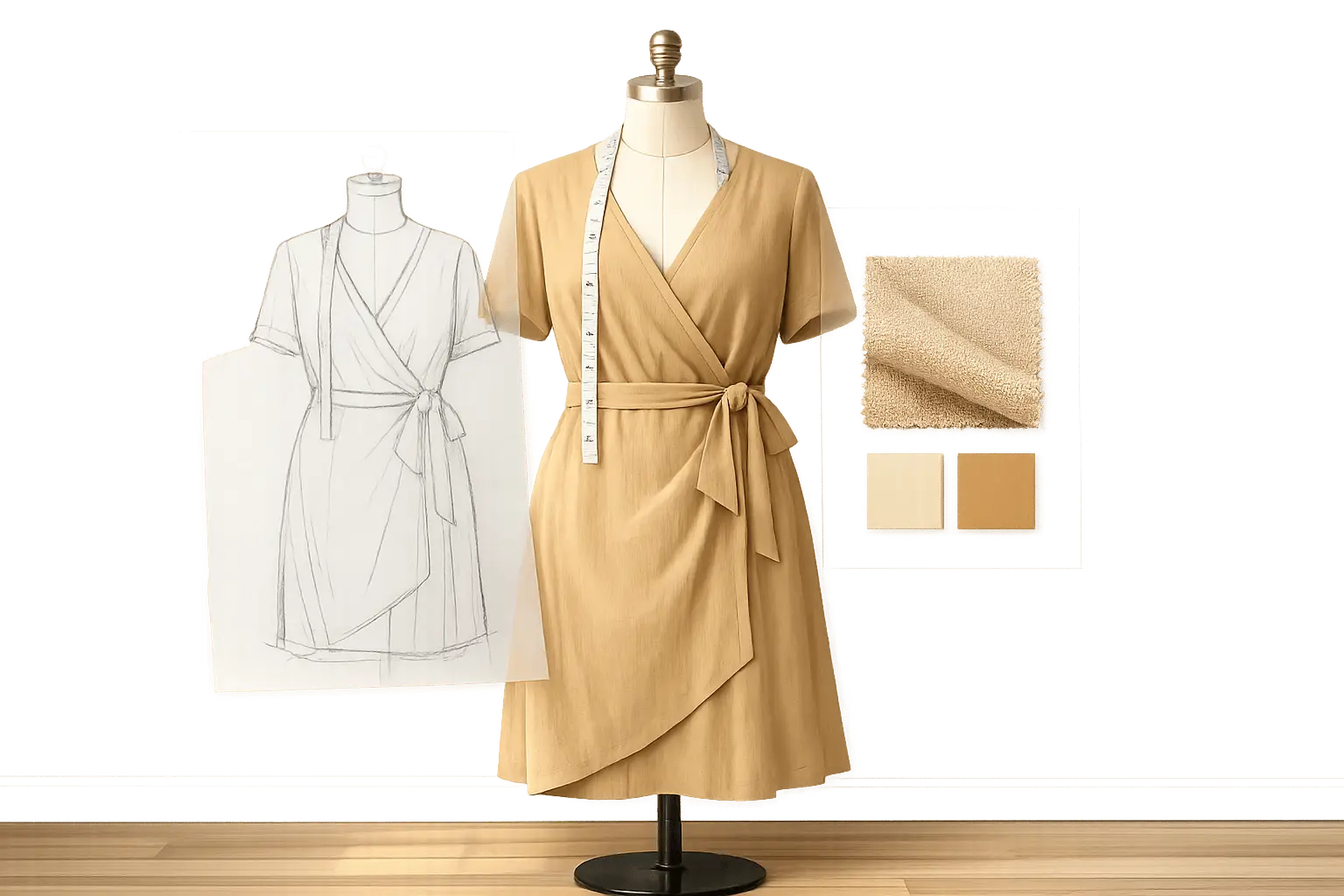
Generative AI is transforming fashion design by turning text, sketches, or photos into realistic mockups and 3D visuals in seconds. Tools like Mock It AI simplify workflows, reduce costs, and minimize waste by replacing physical samples with digital prototypes. Designers can experiment with styles, colors, and fabrics faster, while brands save time and resources. Key advancements include:
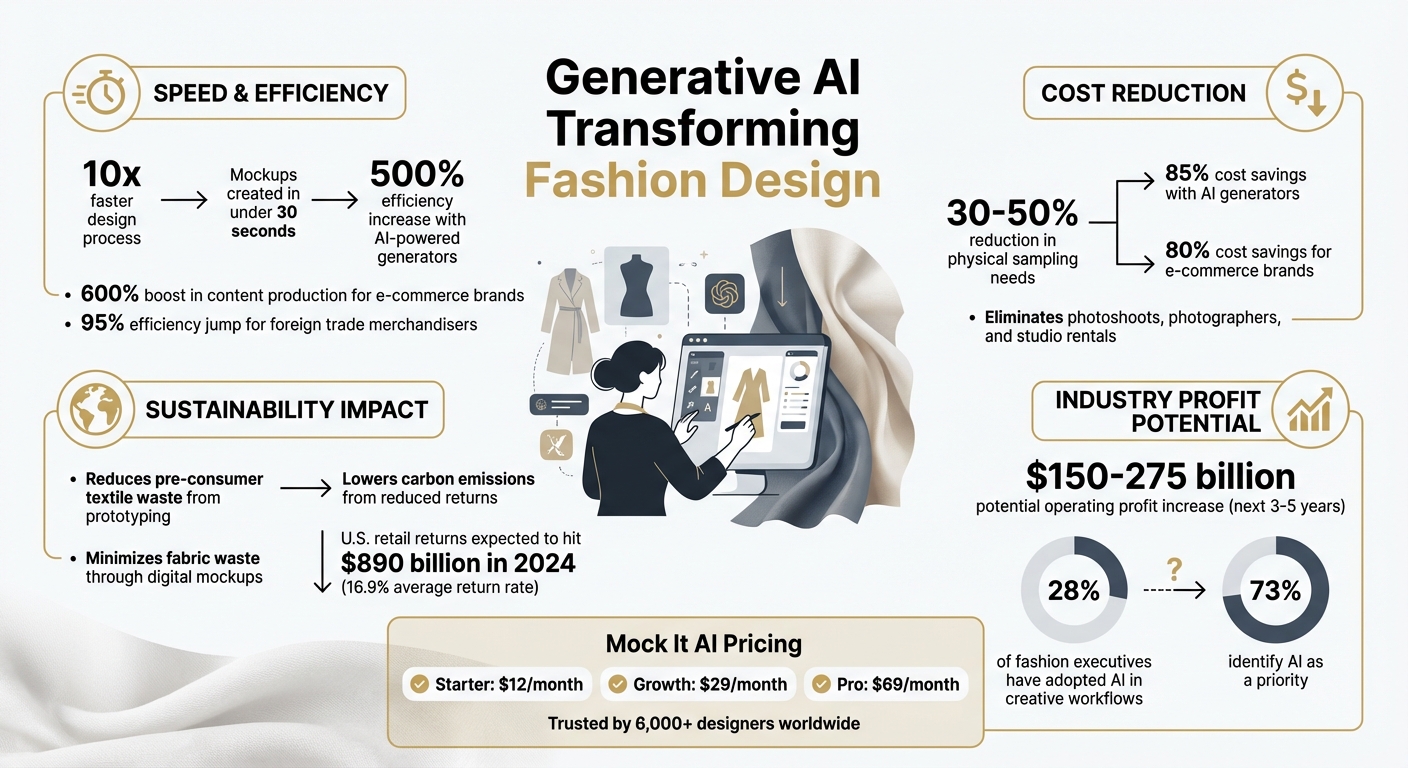
Faster Design Process: AI tools reduce design time by up to 10x and cut physical sampling needs by 30%-50%.
Cost Efficiency: AI-generated mockups eliminate photoshoots and save brands significant expenses.
Sustainability: Digital mockups help reduce fabric waste and lower returns, addressing industry challenges.
Mock It AI, a leading platform, offers plans starting at $12/month, enabling users to create professional mockups in under 30 seconds. With AI’s growing role in fashion, these tools are reshaping how brands design, market, and produce garments.
AI-driven fashion mockups have come a long way, thanks to the shift from GANs (Generative Adversarial Networks) to Latent Diffusion Models. While GANs were once the go-to for creating realistic images, diffusion models now take the spotlight. They’re better at handling complex tasks, like transforming text descriptions into detailed garment designs, with greater reliability and precision. These models rely on a UNet denoising backbone combined with Additive Self-Attention layers, which help maintain intricate details like fabric textures and stitching.
Advanced systems like Garment3DGen and Image2Garment push this technology further by producing 3D assets that are simulation-ready and exhibit lifelike fabric physics. These systems use differentiable physics and per-triangle Jacobians to morph a base template into a fully-realized garment, ensuring the garment’s structure and topology remain intact. Multi-view diffusion adds another layer of sophistication by generating consistent visuals from various angles, which can then be reconstructed into 3D geometries using just a single 2D input.
For handling textures, FabricDiffusion (introduced in October 2024) extracts seamless, tileable texture maps from photos and applies them to 3D garments using Physically-Based Rendering techniques. Meanwhile, tools like ControlNet provide spatial control for virtual try-ons and sketch-to-image conversions, while LoRA (Low-Rank Adaptation) fine-tunes models on specialized fashion datasets for heightened accuracy. These technological advancements are laying the groundwork for even more efficient and realistic AI-powered fashion design.
Recent Developments in AI-Powered Fashion Design
The latest innovations are making AI-powered fashion design even more efficient and lifelike. Take ChatGarment, for example. Launched in April 2025, this tool combines Vision-Language Models (VLMs) to let designers create, modify, and estimate 3D garments through simple conversations. By converting text or image inputs into structured JSON files, it even guides the creation of sewing patterns. Another standout, StableGarment (released in March 2024), uses ASA layers within Stable Diffusion to preserve intricate textures while enabling controllable and stylized image generation.
These tools aren’t just improving design quality – they’re revolutionizing the workflow. AI-powered fashion generators can increase efficiency by 500% and cut costs by 85%. E-commerce brands, for instance, report a 600% boost in content production and 80% cost savings. Similarly, foreign trade merchandisers have seen a 95% jump in efficiency and a 200% improvement in performance, all thanks to AI-driven design cycles. What used to take weeks in the traditional design-to-sample process can now be accomplished in a matter of hours.
"Generative AI will be a cornerstone technology that will allow anyone, from novice users to experts, to create customized avatars and to contribute to building personalized virtual experiences." – Nikolaos Sarafianos, Meta Reality Labs
Mock It AI simplifies the creative process into four straightforward steps: build a digital model, choose apparel, set the scene with location and lighting, and upload your design for precise 3D mapping. Users can create a custom digital model by selecting attributes like gender, age, ethnicity, hairstyle, hair color, pose, and facial expression. Once the model is set, they can pick from a range of clothing options, including t-shirts, hoodies, sweatshirts, tank tops, v-necks, jeans, cargo pants, and accessories like hats and shoes. For the third step, users specify or describe a location and fine-tune lighting and environmental details to match their vision. Finally, by uploading their design, the platform’s 3D mapping technology ensures the artwork seamlessly integrates with the fabric, even accounting for folds and wrinkles for a hyper-realistic look.
The platform’s prompt builder removes the complexity of technical jargon, enabling users to generate high-quality images in under 30 seconds with just a few clicks. For those seeking greater control, advanced settings let brands tweak camera type, lens specifications, depth of field, and lighting. Additional editing tools enhance fabric textures, ensuring the final output looks polished and professional.
"Mock It AI lets me produce quality product images in just an hour, streamlining my workflow." – Sarah M., Tiny Clothing Brand Owner
With over 6,000 fashion designers and clothing brands relying on it worldwide, Mock It AI delivers mockups quickly and offers high-resolution downloads in square (1024×1024 px), portrait (1024×1536 px), and landscape (1536×1024 px) formats. As one brand owner shared, "I get professional mockups in under a minute without going back and forth on prompts. I used to pay designers, now it’s part of my workflow".
These user-friendly features, combined with flexible pricing, make Mock It AI an invaluable tool for modern fashion businesses.
Pricing Plans for Different Business Needs
Mock It AI operates on a credit-based system, where each image costs one credit. Here’s a breakdown of the plans:
Starter Plan: $12/month for 100 credits and storage for up to 10 mockups. Perfect for small business owners or those managing a side hustle.
Growth Plan: $29/month for 250 credits and storage for up to 50 mockups. Tailored for startups ramping up their content production.
Pro Plan: $69/month for 650 credits, full feature access, and storage for up to 50 mockups. Ideal for creative leads and businesses with high-volume needs.
All plans include essential features like custom model creation, clothing selection, advanced camera and lens settings, and commercial usage rights for marketing and e-commerce. By cutting out the need for physical photoshoots, professional photographers, and studio rentals, users report substantial cost savings.
To make things even easier, Mock It AI offers a free trial with 30 credits – no payment details required – so new users can explore the platform risk-free. This cost-effective approach aligns with the industry’s push toward faster, more efficient workflows, helping businesses stay ahead in a competitive market.
Impact of Generative AI on Fashion Design Processes
Faster Prototyping and Time Savings
Generative AI is reshaping how fashion design moves from concept to creation. By automating tasks like market analysis, trend forecasting, and initial design work, it significantly speeds up the process. Designers can now turn sketches or text descriptions into detailed 3D models and photorealistic visuals almost instantly.
This acceleration has a direct impact on profitability. According to McKinsey & Company, generative AI could boost operating profits in the apparel, fashion, and luxury sectors by $150 billion to $275 billion over the next three to five years. Yet, despite this potential, only 28% of fashion executives have adopted AI in their creative workflows, even though 73% identify it as a priority. This gap presents a massive opportunity for early adopters.
AI tools also streamline the production pipeline. For example, they reduce the time required to create marketing assets by generating on-model visuals without the need for physical photoshoots. Designers can quickly produce 6–12 variations of a design, helping teams make decisions faster before moving on to technical drawings or samples. Tasks like testing color combinations, trims, and details with sourcing partners, which once took weeks, can now be completed in hours.
Beyond saving time, these advancements also contribute to more sustainable practices.
Reducing Waste Through Digital Mockups
The fashion industry generates considerable waste during the production of physical samples. Generative AI tackles this issue by enabling designers to create and refine concepts using high-quality digital mockups instead of cutting fabric. This approach specifically addresses pre-consumer textile waste that arises during traditional prototyping and pattern cutting.
With virtual prototyping tools, designers can quickly experiment with styles, fabrics, and colors without consuming physical resources. Advanced AI systems even simulate how fabrics drape on 3D models in real-time. Virtual try-on technology further enhances this process by helping customers see how garments will fit and move on different body types, which boosts fit confidence and reduces the environmental burden of returns. This is significant, considering that U.S. retail returns are expected to hit $890 billion in 2024, with an average return rate of 16.9%.
The benefits go beyond waste reduction. By minimizing unnecessary shipments and returns, AI-powered tools help lower carbon emissions across the supply chain. These efficiencies not only reduce costs but also highlight how digital advancements are shaping the future of fashion design.
Future Research and Trends in AI for Fashion
Video-Based Fashion Mockups
Fashion is evolving beyond static images, embracing video mockups that showcase garments in motion. Tools like Dress&Dance, introduced in August 2025, generate 5-second videos at 24 fps with a resolution of 1152×720. This shift is crucial for designers, as it lets them observe how fabrics move and interact in real-time – details that flat images simply can’t convey.
Recent advancements aim to preserve garment details across frames. FashionMAC, launched in January 2026, uses outpainting techniques to eliminate the distortions seen in earlier systems, ensuring textures and patterns remain consistent as the model moves. Another milestone came with Fashion-VDM in November 2024, which produces 64-frame videos at 512px resolution in a single pass, thanks to advanced temporal training methods.
These developments set the stage for even more dynamic applications in digital fashion. Minute-long video generation is becoming the next frontier. Systems like Virtual Fitting Room use auto-regressive, segment-by-segment generation to create extended content, such as full runway presentations or marketing campaigns, from a single garment image. As researchers Zixun Fang and colleagues explained, "Directly applying the technique of image-based try-on to the video domain in a frame-wise manner will cause temporal-inconsistent outcomes". These newer approaches solve that issue, ensuring smoother and more cohesive results.
While video mockups are transforming how designers and brands visualize garments, API integrations are also revolutionizing scalability in AI-driven fashion.
API Integrations and Scalable Solutions
In addition to video innovations, API integrations are making it easier for brands to adopt AI at scale. Instead of relying on standalone software, modern APIs connect directly to platforms like Shopify using RESTful architectures. This allows businesses to process large volumes of mockups programmatically, eliminating the need for manual effort.
A significant step occurred in April 2024 when FASHN partnered with the generative media platform fal.ai to release a virtual try-on API. Powered by fal’s proprietary Inference Engine, this system can produce try-on results at 576×864 resolution in just 15 seconds – up to four times faster than traditional methods. The platform also offers developer-friendly SDKs for Python, JavaScript, and Swift, ensuring compatibility across various tech stacks.
Modern fashion APIs employ asynchronous workflows (Create → Poll → Done) to handle high volumes efficiently without straining system resources. Specialized endpoints like Model Create, Model Swap, and Edit give brands precise control over factors like demographics, poses, and garment details. Processing times vary depending on complexity: background removal takes about 3 seconds, while complex virtual try-ons finish in roughly 17 seconds. These integrations are democratizing access to advanced AI tools, making them practical for brands of all sizes – even those without dedicated tech teams.
How To Create Your Own Studio Model Mockups Completely Free Using AI
Conclusion
Generative AI is changing the way fashion brands approach design, marketing, and production. Tools like Mock It AI allow designers to turn ideas into polished visuals in under 30 seconds. With features like fully customizable, AI-driven photoshoots, users can create models, choose clothing, describe locations, and upload designs to generate unique mockups instantly. This eliminates the need for traditional, expensive photoshoots. Trusted by over 6,000 designers worldwide, Mock It AI offers plans starting at just $12/month for 100 mockups.
"I was about to do a small photoshoot last fall. It was going to cost a few hundred dollars… but I hit pause… I’m a very happy customer with a few hundred extra dollars in my pocket and some awesome looking product photos." – Robert H., verified subscriber
Digital mockups also help brands cut fabric waste and minimize unsold inventory by enabling them to test concepts, visualize products, and make adjustments before moving to production. Advanced features like 3D mapping ensure designs fit realistically around garment folds, delivering production-ready visuals without the need for physical prototypes. These benefits are just the beginning of what AI can offer the fashion industry.
In the near future, tools like Mock It AI could introduce video-based mockups and scalable API integrations, enabling brands to generate marketing content programmatically. As these tools evolve, they’re not just speeding up workflows – they’re also unlocking new creative possibilities. Generative AI is quickly becoming a key technology that’s making fashion more efficient, accessible, and imaginative.
FAQs
What do I need to upload to create a fashion mockup?
To make a fashion mockup, start by uploading your high-quality design artwork. Make sure your file is set to 300 DPI, uses RGB color mode, and has clean, sharp edges to achieve optimal results.
How accurate are AI mockups for fabric texture and drape?
AI mockups now offer impressively lifelike fabric textures and draping effects. With tools like FabricDiffusion, designers can achieve detailed texture transfer for 3D garments. This means fabric details are visualized with striking accuracy, allowing for more precise and refined designs.
Can I use Mock It AI images commercially for my store and ads?
Yes, you can use Mock It AI images for commercial purposes, including in your store and advertising campaigns. Thousands of designers and businesses rely on these tools to create professional, high-quality mockups tailored for commercial use.
Generative AI is transforming fashion design by turning text, sketches, or photos into realistic mockups and 3D visuals in seconds. Tools like Mock It AI simplify workflows, reduce costs, and minimize waste by replacing physical samples with digital prototypes. Designers can experiment with styles, colors, and fabrics faster, while brands save time and resources. Key advancements include:
Faster Design Process: AI tools reduce design time by up to 10x and cut physical sampling needs by 30%-50%.
Cost Efficiency: AI-generated mockups eliminate photoshoots and save brands significant expenses.
Sustainability: Digital mockups help reduce fabric waste and lower returns, addressing industry challenges.
Mock It AI, a leading platform, offers plans starting at $12/month, enabling users to create professional mockups in under 30 seconds. With AI’s growing role in fashion, these tools are reshaping how brands design, market, and produce garments.
AI-driven fashion mockups have come a long way, thanks to the shift from GANs (Generative Adversarial Networks) to Latent Diffusion Models. While GANs were once the go-to for creating realistic images, diffusion models now take the spotlight. They’re better at handling complex tasks, like transforming text descriptions into detailed garment designs, with greater reliability and precision. These models rely on a UNet denoising backbone combined with Additive Self-Attention layers, which help maintain intricate details like fabric textures and stitching.
Advanced systems like Garment3DGen and Image2Garment push this technology further by producing 3D assets that are simulation-ready and exhibit lifelike fabric physics. These systems use differentiable physics and per-triangle Jacobians to morph a base template into a fully-realized garment, ensuring the garment’s structure and topology remain intact. Multi-view diffusion adds another layer of sophistication by generating consistent visuals from various angles, which can then be reconstructed into 3D geometries using just a single 2D input.
For handling textures, FabricDiffusion (introduced in October 2024) extracts seamless, tileable texture maps from photos and applies them to 3D garments using Physically-Based Rendering techniques. Meanwhile, tools like ControlNet provide spatial control for virtual try-ons and sketch-to-image conversions, while LoRA (Low-Rank Adaptation) fine-tunes models on specialized fashion datasets for heightened accuracy. These technological advancements are laying the groundwork for even more efficient and realistic AI-powered fashion design.
Recent Developments in AI-Powered Fashion Design
The latest innovations are making AI-powered fashion design even more efficient and lifelike. Take ChatGarment, for example. Launched in April 2025, this tool combines Vision-Language Models (VLMs) to let designers create, modify, and estimate 3D garments through simple conversations. By converting text or image inputs into structured JSON files, it even guides the creation of sewing patterns. Another standout, StableGarment (released in March 2024), uses ASA layers within Stable Diffusion to preserve intricate textures while enabling controllable and stylized image generation.
These tools aren’t just improving design quality – they’re revolutionizing the workflow. AI-powered fashion generators can increase efficiency by 500% and cut costs by 85%. E-commerce brands, for instance, report a 600% boost in content production and 80% cost savings. Similarly, foreign trade merchandisers have seen a 95% jump in efficiency and a 200% improvement in performance, all thanks to AI-driven design cycles. What used to take weeks in the traditional design-to-sample process can now be accomplished in a matter of hours.
"Generative AI will be a cornerstone technology that will allow anyone, from novice users to experts, to create customized avatars and to contribute to building personalized virtual experiences." – Nikolaos Sarafianos, Meta Reality Labs
Mock It AI simplifies the creative process into four straightforward steps: build a digital model, choose apparel, set the scene with location and lighting, and upload your design for precise 3D mapping. Users can create a custom digital model by selecting attributes like gender, age, ethnicity, hairstyle, hair color, pose, and facial expression. Once the model is set, they can pick from a range of clothing options, including t-shirts, hoodies, sweatshirts, tank tops, v-necks, jeans, cargo pants, and accessories like hats and shoes. For the third step, users specify or describe a location and fine-tune lighting and environmental details to match their vision. Finally, by uploading their design, the platform’s 3D mapping technology ensures the artwork seamlessly integrates with the fabric, even accounting for folds and wrinkles for a hyper-realistic look.
The platform’s prompt builder removes the complexity of technical jargon, enabling users to generate high-quality images in under 30 seconds with just a few clicks. For those seeking greater control, advanced settings let brands tweak camera type, lens specifications, depth of field, and lighting. Additional editing tools enhance fabric textures, ensuring the final output looks polished and professional.
"Mock It AI lets me produce quality product images in just an hour, streamlining my workflow." – Sarah M., Tiny Clothing Brand Owner
With over 6,000 fashion designers and clothing brands relying on it worldwide, Mock It AI delivers mockups quickly and offers high-resolution downloads in square (1024×1024 px), portrait (1024×1536 px), and landscape (1536×1024 px) formats. As one brand owner shared, "I get professional mockups in under a minute without going back and forth on prompts. I used to pay designers, now it’s part of my workflow".
These user-friendly features, combined with flexible pricing, make Mock It AI an invaluable tool for modern fashion businesses.
Pricing Plans for Different Business Needs
Mock It AI operates on a credit-based system, where each image costs one credit. Here’s a breakdown of the plans:
Starter Plan: $12/month for 100 credits and storage for up to 10 mockups. Perfect for small business owners or those managing a side hustle.
Growth Plan: $29/month for 250 credits and storage for up to 50 mockups. Tailored for startups ramping up their content production.
Pro Plan: $69/month for 650 credits, full feature access, and storage for up to 50 mockups. Ideal for creative leads and businesses with high-volume needs.
All plans include essential features like custom model creation, clothing selection, advanced camera and lens settings, and commercial usage rights for marketing and e-commerce. By cutting out the need for physical photoshoots, professional photographers, and studio rentals, users report substantial cost savings.
To make things even easier, Mock It AI offers a free trial with 30 credits – no payment details required – so new users can explore the platform risk-free. This cost-effective approach aligns with the industry’s push toward faster, more efficient workflows, helping businesses stay ahead in a competitive market.
Impact of Generative AI on Fashion Design Processes
Faster Prototyping and Time Savings
Generative AI is reshaping how fashion design moves from concept to creation. By automating tasks like market analysis, trend forecasting, and initial design work, it significantly speeds up the process. Designers can now turn sketches or text descriptions into detailed 3D models and photorealistic visuals almost instantly.
This acceleration has a direct impact on profitability. According to McKinsey & Company, generative AI could boost operating profits in the apparel, fashion, and luxury sectors by $150 billion to $275 billion over the next three to five years. Yet, despite this potential, only 28% of fashion executives have adopted AI in their creative workflows, even though 73% identify it as a priority. This gap presents a massive opportunity for early adopters.
AI tools also streamline the production pipeline. For example, they reduce the time required to create marketing assets by generating on-model visuals without the need for physical photoshoots. Designers can quickly produce 6–12 variations of a design, helping teams make decisions faster before moving on to technical drawings or samples. Tasks like testing color combinations, trims, and details with sourcing partners, which once took weeks, can now be completed in hours.
Beyond saving time, these advancements also contribute to more sustainable practices.
Reducing Waste Through Digital Mockups
The fashion industry generates considerable waste during the production of physical samples. Generative AI tackles this issue by enabling designers to create and refine concepts using high-quality digital mockups instead of cutting fabric. This approach specifically addresses pre-consumer textile waste that arises during traditional prototyping and pattern cutting.
With virtual prototyping tools, designers can quickly experiment with styles, fabrics, and colors without consuming physical resources. Advanced AI systems even simulate how fabrics drape on 3D models in real-time. Virtual try-on technology further enhances this process by helping customers see how garments will fit and move on different body types, which boosts fit confidence and reduces the environmental burden of returns. This is significant, considering that U.S. retail returns are expected to hit $890 billion in 2024, with an average return rate of 16.9%.
The benefits go beyond waste reduction. By minimizing unnecessary shipments and returns, AI-powered tools help lower carbon emissions across the supply chain. These efficiencies not only reduce costs but also highlight how digital advancements are shaping the future of fashion design.
Future Research and Trends in AI for Fashion
Video-Based Fashion Mockups
Fashion is evolving beyond static images, embracing video mockups that showcase garments in motion. Tools like Dress&Dance, introduced in August 2025, generate 5-second videos at 24 fps with a resolution of 1152×720. This shift is crucial for designers, as it lets them observe how fabrics move and interact in real-time – details that flat images simply can’t convey.
Recent advancements aim to preserve garment details across frames. FashionMAC, launched in January 2026, uses outpainting techniques to eliminate the distortions seen in earlier systems, ensuring textures and patterns remain consistent as the model moves. Another milestone came with Fashion-VDM in November 2024, which produces 64-frame videos at 512px resolution in a single pass, thanks to advanced temporal training methods.
These developments set the stage for even more dynamic applications in digital fashion. Minute-long video generation is becoming the next frontier. Systems like Virtual Fitting Room use auto-regressive, segment-by-segment generation to create extended content, such as full runway presentations or marketing campaigns, from a single garment image. As researchers Zixun Fang and colleagues explained, "Directly applying the technique of image-based try-on to the video domain in a frame-wise manner will cause temporal-inconsistent outcomes". These newer approaches solve that issue, ensuring smoother and more cohesive results.
While video mockups are transforming how designers and brands visualize garments, API integrations are also revolutionizing scalability in AI-driven fashion.
API Integrations and Scalable Solutions
In addition to video innovations, API integrations are making it easier for brands to adopt AI at scale. Instead of relying on standalone software, modern APIs connect directly to platforms like Shopify using RESTful architectures. This allows businesses to process large volumes of mockups programmatically, eliminating the need for manual effort.
A significant step occurred in April 2024 when FASHN partnered with the generative media platform fal.ai to release a virtual try-on API. Powered by fal’s proprietary Inference Engine, this system can produce try-on results at 576×864 resolution in just 15 seconds – up to four times faster than traditional methods. The platform also offers developer-friendly SDKs for Python, JavaScript, and Swift, ensuring compatibility across various tech stacks.
Modern fashion APIs employ asynchronous workflows (Create → Poll → Done) to handle high volumes efficiently without straining system resources. Specialized endpoints like Model Create, Model Swap, and Edit give brands precise control over factors like demographics, poses, and garment details. Processing times vary depending on complexity: background removal takes about 3 seconds, while complex virtual try-ons finish in roughly 17 seconds. These integrations are democratizing access to advanced AI tools, making them practical for brands of all sizes – even those without dedicated tech teams.
How To Create Your Own Studio Model Mockups Completely Free Using AI
Conclusion
Generative AI is changing the way fashion brands approach design, marketing, and production. Tools like Mock It AI allow designers to turn ideas into polished visuals in under 30 seconds. With features like fully customizable, AI-driven photoshoots, users can create models, choose clothing, describe locations, and upload designs to generate unique mockups instantly. This eliminates the need for traditional, expensive photoshoots. Trusted by over 6,000 designers worldwide, Mock It AI offers plans starting at just $12/month for 100 mockups.
"I was about to do a small photoshoot last fall. It was going to cost a few hundred dollars… but I hit pause… I’m a very happy customer with a few hundred extra dollars in my pocket and some awesome looking product photos." – Robert H., verified subscriber
Digital mockups also help brands cut fabric waste and minimize unsold inventory by enabling them to test concepts, visualize products, and make adjustments before moving to production. Advanced features like 3D mapping ensure designs fit realistically around garment folds, delivering production-ready visuals without the need for physical prototypes. These benefits are just the beginning of what AI can offer the fashion industry.
In the near future, tools like Mock It AI could introduce video-based mockups and scalable API integrations, enabling brands to generate marketing content programmatically. As these tools evolve, they’re not just speeding up workflows – they’re also unlocking new creative possibilities. Generative AI is quickly becoming a key technology that’s making fashion more efficient, accessible, and imaginative.
FAQs
What do I need to upload to create a fashion mockup?
To make a fashion mockup, start by uploading your high-quality design artwork. Make sure your file is set to 300 DPI, uses RGB color mode, and has clean, sharp edges to achieve optimal results.
How accurate are AI mockups for fabric texture and drape?
AI mockups now offer impressively lifelike fabric textures and draping effects. With tools like FabricDiffusion, designers can achieve detailed texture transfer for 3D garments. This means fabric details are visualized with striking accuracy, allowing for more precise and refined designs.
Can I use Mock It AI images commercially for my store and ads?
Yes, you can use Mock It AI images for commercial purposes, including in your store and advertising campaigns. Thousands of designers and businesses rely on these tools to create professional, high-quality mockups tailored for commercial use.
Jeremy P is the Founder and Owner of Mock It AI, Mock It, and Pixel Sauce. With years of experience, Jeremy has assisted thousands of brands, designers, and individuals in creating high-quality product images and mockups for their businesses and clients. A pioneer and leader in the apparel mockup space, Jeremy is dedicated to finding innovative ways to help brands and designers enhance their visual content. His expertise and forward-thinking approach make him a prominent figure in the industry.
Generative AI is transforming fashion design by turning text, sketches, or photos into realistic mockups and 3D visuals in seconds. Tools like Mock It AI simplify workflows, reduce costs, and minimize waste by replacing physical samples with digital prototypes. Designers can experiment with styles, colors, and fabrics faster, while brands save time and resources. Key advancements include:
Faster Design Process: AI tools reduce design time by up to 10x and cut physical sampling needs by 30%-50%.
Cost Efficiency: AI-generated mockups eliminate photoshoots and save brands significant expenses.
Sustainability: Digital mockups help reduce fabric waste and lower returns, addressing industry challenges.
Mock It AI, a leading platform, offers plans starting at $12/month, enabling users to create professional mockups in under 30 seconds. With AI’s growing role in fashion, these tools are reshaping how brands design, market, and produce garments.
AI-driven fashion mockups have come a long way, thanks to the shift from GANs (Generative Adversarial Networks) to Latent Diffusion Models. While GANs were once the go-to for creating realistic images, diffusion models now take the spotlight. They’re better at handling complex tasks, like transforming text descriptions into detailed garment designs, with greater reliability and precision. These models rely on a UNet denoising backbone combined with Additive Self-Attention layers, which help maintain intricate details like fabric textures and stitching.
Advanced systems like Garment3DGen and Image2Garment push this technology further by producing 3D assets that are simulation-ready and exhibit lifelike fabric physics. These systems use differentiable physics and per-triangle Jacobians to morph a base template into a fully-realized garment, ensuring the garment’s structure and topology remain intact. Multi-view diffusion adds another layer of sophistication by generating consistent visuals from various angles, which can then be reconstructed into 3D geometries using just a single 2D input.
For handling textures, FabricDiffusion (introduced in October 2024) extracts seamless, tileable texture maps from photos and applies them to 3D garments using Physically-Based Rendering techniques. Meanwhile, tools like ControlNet provide spatial control for virtual try-ons and sketch-to-image conversions, while LoRA (Low-Rank Adaptation) fine-tunes models on specialized fashion datasets for heightened accuracy. These technological advancements are laying the groundwork for even more efficient and realistic AI-powered fashion design.
Recent Developments in AI-Powered Fashion Design
The latest innovations are making AI-powered fashion design even more efficient and lifelike. Take ChatGarment, for example. Launched in April 2025, this tool combines Vision-Language Models (VLMs) to let designers create, modify, and estimate 3D garments through simple conversations. By converting text or image inputs into structured JSON files, it even guides the creation of sewing patterns. Another standout, StableGarment (released in March 2024), uses ASA layers within Stable Diffusion to preserve intricate textures while enabling controllable and stylized image generation.
These tools aren’t just improving design quality – they’re revolutionizing the workflow. AI-powered fashion generators can increase efficiency by 500% and cut costs by 85%. E-commerce brands, for instance, report a 600% boost in content production and 80% cost savings. Similarly, foreign trade merchandisers have seen a 95% jump in efficiency and a 200% improvement in performance, all thanks to AI-driven design cycles. What used to take weeks in the traditional design-to-sample process can now be accomplished in a matter of hours.
"Generative AI will be a cornerstone technology that will allow anyone, from novice users to experts, to create customized avatars and to contribute to building personalized virtual experiences." – Nikolaos Sarafianos, Meta Reality Labs
Mock It AI simplifies the creative process into four straightforward steps: build a digital model, choose apparel, set the scene with location and lighting, and upload your design for precise 3D mapping. Users can create a custom digital model by selecting attributes like gender, age, ethnicity, hairstyle, hair color, pose, and facial expression. Once the model is set, they can pick from a range of clothing options, including t-shirts, hoodies, sweatshirts, tank tops, v-necks, jeans, cargo pants, and accessories like hats and shoes. For the third step, users specify or describe a location and fine-tune lighting and environmental details to match their vision. Finally, by uploading their design, the platform’s 3D mapping technology ensures the artwork seamlessly integrates with the fabric, even accounting for folds and wrinkles for a hyper-realistic look.
The platform’s prompt builder removes the complexity of technical jargon, enabling users to generate high-quality images in under 30 seconds with just a few clicks. For those seeking greater control, advanced settings let brands tweak camera type, lens specifications, depth of field, and lighting. Additional editing tools enhance fabric textures, ensuring the final output looks polished and professional.
"Mock It AI lets me produce quality product images in just an hour, streamlining my workflow." – Sarah M., Tiny Clothing Brand Owner
With over 6,000 fashion designers and clothing brands relying on it worldwide, Mock It AI delivers mockups quickly and offers high-resolution downloads in square (1024×1024 px), portrait (1024×1536 px), and landscape (1536×1024 px) formats. As one brand owner shared, "I get professional mockups in under a minute without going back and forth on prompts. I used to pay designers, now it’s part of my workflow".
These user-friendly features, combined with flexible pricing, make Mock It AI an invaluable tool for modern fashion businesses.
Pricing Plans for Different Business Needs
Mock It AI operates on a credit-based system, where each image costs one credit. Here’s a breakdown of the plans:
Starter Plan: $12/month for 100 credits and storage for up to 10 mockups. Perfect for small business owners or those managing a side hustle.
Growth Plan: $29/month for 250 credits and storage for up to 50 mockups. Tailored for startups ramping up their content production.
Pro Plan: $69/month for 650 credits, full feature access, and storage for up to 50 mockups. Ideal for creative leads and businesses with high-volume needs.
All plans include essential features like custom model creation, clothing selection, advanced camera and lens settings, and commercial usage rights for marketing and e-commerce. By cutting out the need for physical photoshoots, professional photographers, and studio rentals, users report substantial cost savings.
To make things even easier, Mock It AI offers a free trial with 30 credits – no payment details required – so new users can explore the platform risk-free. This cost-effective approach aligns with the industry’s push toward faster, more efficient workflows, helping businesses stay ahead in a competitive market.
Impact of Generative AI on Fashion Design Processes
Faster Prototyping and Time Savings
Generative AI is reshaping how fashion design moves from concept to creation. By automating tasks like market analysis, trend forecasting, and initial design work, it significantly speeds up the process. Designers can now turn sketches or text descriptions into detailed 3D models and photorealistic visuals almost instantly.
This acceleration has a direct impact on profitability. According to McKinsey & Company, generative AI could boost operating profits in the apparel, fashion, and luxury sectors by $150 billion to $275 billion over the next three to five years. Yet, despite this potential, only 28% of fashion executives have adopted AI in their creative workflows, even though 73% identify it as a priority. This gap presents a massive opportunity for early adopters.
AI tools also streamline the production pipeline. For example, they reduce the time required to create marketing assets by generating on-model visuals without the need for physical photoshoots. Designers can quickly produce 6–12 variations of a design, helping teams make decisions faster before moving on to technical drawings or samples. Tasks like testing color combinations, trims, and details with sourcing partners, which once took weeks, can now be completed in hours.
Beyond saving time, these advancements also contribute to more sustainable practices.
Reducing Waste Through Digital Mockups
The fashion industry generates considerable waste during the production of physical samples. Generative AI tackles this issue by enabling designers to create and refine concepts using high-quality digital mockups instead of cutting fabric. This approach specifically addresses pre-consumer textile waste that arises during traditional prototyping and pattern cutting.
With virtual prototyping tools, designers can quickly experiment with styles, fabrics, and colors without consuming physical resources. Advanced AI systems even simulate how fabrics drape on 3D models in real-time. Virtual try-on technology further enhances this process by helping customers see how garments will fit and move on different body types, which boosts fit confidence and reduces the environmental burden of returns. This is significant, considering that U.S. retail returns are expected to hit $890 billion in 2024, with an average return rate of 16.9%.
The benefits go beyond waste reduction. By minimizing unnecessary shipments and returns, AI-powered tools help lower carbon emissions across the supply chain. These efficiencies not only reduce costs but also highlight how digital advancements are shaping the future of fashion design.
Future Research and Trends in AI for Fashion
Video-Based Fashion Mockups
Fashion is evolving beyond static images, embracing video mockups that showcase garments in motion. Tools like Dress&Dance, introduced in August 2025, generate 5-second videos at 24 fps with a resolution of 1152×720. This shift is crucial for designers, as it lets them observe how fabrics move and interact in real-time – details that flat images simply can’t convey.
Recent advancements aim to preserve garment details across frames. FashionMAC, launched in January 2026, uses outpainting techniques to eliminate the distortions seen in earlier systems, ensuring textures and patterns remain consistent as the model moves. Another milestone came with Fashion-VDM in November 2024, which produces 64-frame videos at 512px resolution in a single pass, thanks to advanced temporal training methods.
These developments set the stage for even more dynamic applications in digital fashion. Minute-long video generation is becoming the next frontier. Systems like Virtual Fitting Room use auto-regressive, segment-by-segment generation to create extended content, such as full runway presentations or marketing campaigns, from a single garment image. As researchers Zixun Fang and colleagues explained, "Directly applying the technique of image-based try-on to the video domain in a frame-wise manner will cause temporal-inconsistent outcomes". These newer approaches solve that issue, ensuring smoother and more cohesive results.
While video mockups are transforming how designers and brands visualize garments, API integrations are also revolutionizing scalability in AI-driven fashion.
API Integrations and Scalable Solutions
In addition to video innovations, API integrations are making it easier for brands to adopt AI at scale. Instead of relying on standalone software, modern APIs connect directly to platforms like Shopify using RESTful architectures. This allows businesses to process large volumes of mockups programmatically, eliminating the need for manual effort.
A significant step occurred in April 2024 when FASHN partnered with the generative media platform fal.ai to release a virtual try-on API. Powered by fal’s proprietary Inference Engine, this system can produce try-on results at 576×864 resolution in just 15 seconds – up to four times faster than traditional methods. The platform also offers developer-friendly SDKs for Python, JavaScript, and Swift, ensuring compatibility across various tech stacks.
Modern fashion APIs employ asynchronous workflows (Create → Poll → Done) to handle high volumes efficiently without straining system resources. Specialized endpoints like Model Create, Model Swap, and Edit give brands precise control over factors like demographics, poses, and garment details. Processing times vary depending on complexity: background removal takes about 3 seconds, while complex virtual try-ons finish in roughly 17 seconds. These integrations are democratizing access to advanced AI tools, making them practical for brands of all sizes – even those without dedicated tech teams.
How To Create Your Own Studio Model Mockups Completely Free Using AI
Conclusion
Generative AI is changing the way fashion brands approach design, marketing, and production. Tools like Mock It AI allow designers to turn ideas into polished visuals in under 30 seconds. With features like fully customizable, AI-driven photoshoots, users can create models, choose clothing, describe locations, and upload designs to generate unique mockups instantly. This eliminates the need for traditional, expensive photoshoots. Trusted by over 6,000 designers worldwide, Mock It AI offers plans starting at just $12/month for 100 mockups.
"I was about to do a small photoshoot last fall. It was going to cost a few hundred dollars… but I hit pause… I’m a very happy customer with a few hundred extra dollars in my pocket and some awesome looking product photos." – Robert H., verified subscriber
Digital mockups also help brands cut fabric waste and minimize unsold inventory by enabling them to test concepts, visualize products, and make adjustments before moving to production. Advanced features like 3D mapping ensure designs fit realistically around garment folds, delivering production-ready visuals without the need for physical prototypes. These benefits are just the beginning of what AI can offer the fashion industry.
In the near future, tools like Mock It AI could introduce video-based mockups and scalable API integrations, enabling brands to generate marketing content programmatically. As these tools evolve, they’re not just speeding up workflows – they’re also unlocking new creative possibilities. Generative AI is quickly becoming a key technology that’s making fashion more efficient, accessible, and imaginative.
FAQs
What do I need to upload to create a fashion mockup?
To make a fashion mockup, start by uploading your high-quality design artwork. Make sure your file is set to 300 DPI, uses RGB color mode, and has clean, sharp edges to achieve optimal results.
How accurate are AI mockups for fabric texture and drape?
AI mockups now offer impressively lifelike fabric textures and draping effects. With tools like FabricDiffusion, designers can achieve detailed texture transfer for 3D garments. This means fabric details are visualized with striking accuracy, allowing for more precise and refined designs.
Can I use Mock It AI images commercially for my store and ads?
Yes, you can use Mock It AI images for commercial purposes, including in your store and advertising campaigns. Thousands of designers and businesses rely on these tools to create professional, high-quality mockups tailored for commercial use.
Generative AI is transforming fashion design by turning text, sketches, or photos into realistic mockups and 3D visuals in seconds. Tools like Mock It AI simplify workflows, reduce costs, and minimize waste by replacing physical samples with digital prototypes. Designers can experiment with styles, colors, and fabrics faster, while brands save time and resources. Key advancements include:
Faster Design Process: AI tools reduce design time by up to 10x and cut physical sampling needs by 30%-50%.
Cost Efficiency: AI-generated mockups eliminate photoshoots and save brands significant expenses.
Sustainability: Digital mockups help reduce fabric waste and lower returns, addressing industry challenges.
Mock It AI, a leading platform, offers plans starting at $12/month, enabling users to create professional mockups in under 30 seconds. With AI’s growing role in fashion, these tools are reshaping how brands design, market, and produce garments.
AI-driven fashion mockups have come a long way, thanks to the shift from GANs (Generative Adversarial Networks) to Latent Diffusion Models. While GANs were once the go-to for creating realistic images, diffusion models now take the spotlight. They’re better at handling complex tasks, like transforming text descriptions into detailed garment designs, with greater reliability and precision. These models rely on a UNet denoising backbone combined with Additive Self-Attention layers, which help maintain intricate details like fabric textures and stitching.
Advanced systems like Garment3DGen and Image2Garment push this technology further by producing 3D assets that are simulation-ready and exhibit lifelike fabric physics. These systems use differentiable physics and per-triangle Jacobians to morph a base template into a fully-realized garment, ensuring the garment’s structure and topology remain intact. Multi-view diffusion adds another layer of sophistication by generating consistent visuals from various angles, which can then be reconstructed into 3D geometries using just a single 2D input.
For handling textures, FabricDiffusion (introduced in October 2024) extracts seamless, tileable texture maps from photos and applies them to 3D garments using Physically-Based Rendering techniques. Meanwhile, tools like ControlNet provide spatial control for virtual try-ons and sketch-to-image conversions, while LoRA (Low-Rank Adaptation) fine-tunes models on specialized fashion datasets for heightened accuracy. These technological advancements are laying the groundwork for even more efficient and realistic AI-powered fashion design.
Recent Developments in AI-Powered Fashion Design
The latest innovations are making AI-powered fashion design even more efficient and lifelike. Take ChatGarment, for example. Launched in April 2025, this tool combines Vision-Language Models (VLMs) to let designers create, modify, and estimate 3D garments through simple conversations. By converting text or image inputs into structured JSON files, it even guides the creation of sewing patterns. Another standout, StableGarment (released in March 2024), uses ASA layers within Stable Diffusion to preserve intricate textures while enabling controllable and stylized image generation.
These tools aren’t just improving design quality – they’re revolutionizing the workflow. AI-powered fashion generators can increase efficiency by 500% and cut costs by 85%. E-commerce brands, for instance, report a 600% boost in content production and 80% cost savings. Similarly, foreign trade merchandisers have seen a 95% jump in efficiency and a 200% improvement in performance, all thanks to AI-driven design cycles. What used to take weeks in the traditional design-to-sample process can now be accomplished in a matter of hours.
"Generative AI will be a cornerstone technology that will allow anyone, from novice users to experts, to create customized avatars and to contribute to building personalized virtual experiences." – Nikolaos Sarafianos, Meta Reality Labs
Mock It AI simplifies the creative process into four straightforward steps: build a digital model, choose apparel, set the scene with location and lighting, and upload your design for precise 3D mapping. Users can create a custom digital model by selecting attributes like gender, age, ethnicity, hairstyle, hair color, pose, and facial expression. Once the model is set, they can pick from a range of clothing options, including t-shirts, hoodies, sweatshirts, tank tops, v-necks, jeans, cargo pants, and accessories like hats and shoes. For the third step, users specify or describe a location and fine-tune lighting and environmental details to match their vision. Finally, by uploading their design, the platform’s 3D mapping technology ensures the artwork seamlessly integrates with the fabric, even accounting for folds and wrinkles for a hyper-realistic look.
The platform’s prompt builder removes the complexity of technical jargon, enabling users to generate high-quality images in under 30 seconds with just a few clicks. For those seeking greater control, advanced settings let brands tweak camera type, lens specifications, depth of field, and lighting. Additional editing tools enhance fabric textures, ensuring the final output looks polished and professional.
"Mock It AI lets me produce quality product images in just an hour, streamlining my workflow." – Sarah M., Tiny Clothing Brand Owner
With over 6,000 fashion designers and clothing brands relying on it worldwide, Mock It AI delivers mockups quickly and offers high-resolution downloads in square (1024×1024 px), portrait (1024×1536 px), and landscape (1536×1024 px) formats. As one brand owner shared, "I get professional mockups in under a minute without going back and forth on prompts. I used to pay designers, now it’s part of my workflow".
These user-friendly features, combined with flexible pricing, make Mock It AI an invaluable tool for modern fashion businesses.
Pricing Plans for Different Business Needs
Mock It AI operates on a credit-based system, where each image costs one credit. Here’s a breakdown of the plans:
Starter Plan: $12/month for 100 credits and storage for up to 10 mockups. Perfect for small business owners or those managing a side hustle.
Growth Plan: $29/month for 250 credits and storage for up to 50 mockups. Tailored for startups ramping up their content production.
Pro Plan: $69/month for 650 credits, full feature access, and storage for up to 50 mockups. Ideal for creative leads and businesses with high-volume needs.
All plans include essential features like custom model creation, clothing selection, advanced camera and lens settings, and commercial usage rights for marketing and e-commerce. By cutting out the need for physical photoshoots, professional photographers, and studio rentals, users report substantial cost savings.
To make things even easier, Mock It AI offers a free trial with 30 credits – no payment details required – so new users can explore the platform risk-free. This cost-effective approach aligns with the industry’s push toward faster, more efficient workflows, helping businesses stay ahead in a competitive market.
Impact of Generative AI on Fashion Design Processes
Faster Prototyping and Time Savings
Generative AI is reshaping how fashion design moves from concept to creation. By automating tasks like market analysis, trend forecasting, and initial design work, it significantly speeds up the process. Designers can now turn sketches or text descriptions into detailed 3D models and photorealistic visuals almost instantly.
This acceleration has a direct impact on profitability. According to McKinsey & Company, generative AI could boost operating profits in the apparel, fashion, and luxury sectors by $150 billion to $275 billion over the next three to five years. Yet, despite this potential, only 28% of fashion executives have adopted AI in their creative workflows, even though 73% identify it as a priority. This gap presents a massive opportunity for early adopters.
AI tools also streamline the production pipeline. For example, they reduce the time required to create marketing assets by generating on-model visuals without the need for physical photoshoots. Designers can quickly produce 6–12 variations of a design, helping teams make decisions faster before moving on to technical drawings or samples. Tasks like testing color combinations, trims, and details with sourcing partners, which once took weeks, can now be completed in hours.
Beyond saving time, these advancements also contribute to more sustainable practices.
Reducing Waste Through Digital Mockups
The fashion industry generates considerable waste during the production of physical samples. Generative AI tackles this issue by enabling designers to create and refine concepts using high-quality digital mockups instead of cutting fabric. This approach specifically addresses pre-consumer textile waste that arises during traditional prototyping and pattern cutting.
With virtual prototyping tools, designers can quickly experiment with styles, fabrics, and colors without consuming physical resources. Advanced AI systems even simulate how fabrics drape on 3D models in real-time. Virtual try-on technology further enhances this process by helping customers see how garments will fit and move on different body types, which boosts fit confidence and reduces the environmental burden of returns. This is significant, considering that U.S. retail returns are expected to hit $890 billion in 2024, with an average return rate of 16.9%.
The benefits go beyond waste reduction. By minimizing unnecessary shipments and returns, AI-powered tools help lower carbon emissions across the supply chain. These efficiencies not only reduce costs but also highlight how digital advancements are shaping the future of fashion design.
Future Research and Trends in AI for Fashion
Video-Based Fashion Mockups
Fashion is evolving beyond static images, embracing video mockups that showcase garments in motion. Tools like Dress&Dance, introduced in August 2025, generate 5-second videos at 24 fps with a resolution of 1152×720. This shift is crucial for designers, as it lets them observe how fabrics move and interact in real-time – details that flat images simply can’t convey.
Recent advancements aim to preserve garment details across frames. FashionMAC, launched in January 2026, uses outpainting techniques to eliminate the distortions seen in earlier systems, ensuring textures and patterns remain consistent as the model moves. Another milestone came with Fashion-VDM in November 2024, which produces 64-frame videos at 512px resolution in a single pass, thanks to advanced temporal training methods.
These developments set the stage for even more dynamic applications in digital fashion. Minute-long video generation is becoming the next frontier. Systems like Virtual Fitting Room use auto-regressive, segment-by-segment generation to create extended content, such as full runway presentations or marketing campaigns, from a single garment image. As researchers Zixun Fang and colleagues explained, "Directly applying the technique of image-based try-on to the video domain in a frame-wise manner will cause temporal-inconsistent outcomes". These newer approaches solve that issue, ensuring smoother and more cohesive results.
While video mockups are transforming how designers and brands visualize garments, API integrations are also revolutionizing scalability in AI-driven fashion.
API Integrations and Scalable Solutions
In addition to video innovations, API integrations are making it easier for brands to adopt AI at scale. Instead of relying on standalone software, modern APIs connect directly to platforms like Shopify using RESTful architectures. This allows businesses to process large volumes of mockups programmatically, eliminating the need for manual effort.
A significant step occurred in April 2024 when FASHN partnered with the generative media platform fal.ai to release a virtual try-on API. Powered by fal’s proprietary Inference Engine, this system can produce try-on results at 576×864 resolution in just 15 seconds – up to four times faster than traditional methods. The platform also offers developer-friendly SDKs for Python, JavaScript, and Swift, ensuring compatibility across various tech stacks.
Modern fashion APIs employ asynchronous workflows (Create → Poll → Done) to handle high volumes efficiently without straining system resources. Specialized endpoints like Model Create, Model Swap, and Edit give brands precise control over factors like demographics, poses, and garment details. Processing times vary depending on complexity: background removal takes about 3 seconds, while complex virtual try-ons finish in roughly 17 seconds. These integrations are democratizing access to advanced AI tools, making them practical for brands of all sizes – even those without dedicated tech teams.
How To Create Your Own Studio Model Mockups Completely Free Using AI
Conclusion
Generative AI is changing the way fashion brands approach design, marketing, and production. Tools like Mock It AI allow designers to turn ideas into polished visuals in under 30 seconds. With features like fully customizable, AI-driven photoshoots, users can create models, choose clothing, describe locations, and upload designs to generate unique mockups instantly. This eliminates the need for traditional, expensive photoshoots. Trusted by over 6,000 designers worldwide, Mock It AI offers plans starting at just $12/month for 100 mockups.
"I was about to do a small photoshoot last fall. It was going to cost a few hundred dollars… but I hit pause… I’m a very happy customer with a few hundred extra dollars in my pocket and some awesome looking product photos." – Robert H., verified subscriber
Digital mockups also help brands cut fabric waste and minimize unsold inventory by enabling them to test concepts, visualize products, and make adjustments before moving to production. Advanced features like 3D mapping ensure designs fit realistically around garment folds, delivering production-ready visuals without the need for physical prototypes. These benefits are just the beginning of what AI can offer the fashion industry.
In the near future, tools like Mock It AI could introduce video-based mockups and scalable API integrations, enabling brands to generate marketing content programmatically. As these tools evolve, they’re not just speeding up workflows – they’re also unlocking new creative possibilities. Generative AI is quickly becoming a key technology that’s making fashion more efficient, accessible, and imaginative.
FAQs
What do I need to upload to create a fashion mockup?
To make a fashion mockup, start by uploading your high-quality design artwork. Make sure your file is set to 300 DPI, uses RGB color mode, and has clean, sharp edges to achieve optimal results.
How accurate are AI mockups for fabric texture and drape?
AI mockups now offer impressively lifelike fabric textures and draping effects. With tools like FabricDiffusion, designers can achieve detailed texture transfer for 3D garments. This means fabric details are visualized with striking accuracy, allowing for more precise and refined designs.
Can I use Mock It AI images commercially for my store and ads?
Yes, you can use Mock It AI images for commercial purposes, including in your store and advertising campaigns. Thousands of designers and businesses rely on these tools to create professional, high-quality mockups tailored for commercial use.
Jeremy P is the Founder and Owner of Mock It AI, Mock It, and Pixel Sauce. With years of experience, Jeremy has assisted thousands of brands, designers, and individuals in creating high-quality product images and mockups for their businesses and clients. A pioneer and leader in the apparel mockup space, Jeremy is dedicated to finding innovative ways to help brands and designers enhance their visual content. His expertise and forward-thinking approach make him a prominent figure in the industry.