AI is transforming the way brands handle product photography, slashing costs and saving time. Here’s the key takeaway: Switching to AI-powered photography can reduce costs by up to 99% and cut production time from weeks to minutes.
Key Points:
Cost Savings: Traditional photography costs $50–$540 per image. With AI, it’s just $0.05–$5.00 per image.
Time Efficiency: AI cuts production timelines from 2–4 weeks to as little as 15 seconds.
Improved ROI: Brands report up to 87% cost reductions and 15–25% higher sell-through rates.
Subscription Pricing: Plans start at $12/month for 100 images, making it affordable for businesses of all sizes.
Eliminates Hidden Costs: No need for studio rentals, models, shipping, or retouching teams.
AI tools like Mock It AI allow brands to create high-quality images quickly and affordably, offering a smarter way to scale without breaking the bank.
Traditional Batch Brand Photography Costs Explained
Traditional photography often comes with hidden expenses that can significantly inflate the initial price tag. It’s important to understand these costs to fully grasp how AI can help reduce them. The per-image rate you see in a quote typically accounts for only about half of the actual expenses. As Magic Blog puts it, the quoted price is just the “tip of the iceberg”.
Studio and Equipment Expenses
Studio-related costs form a major part of traditional photography budgets, even before a single photo is taken. Renting a studio can cost anywhere from $200 to $3,000 per day, depending on the location and included equipment. In cities like New York and Los Angeles, those rates often sit between $500 and $3,000. For brands needing studio space for 10 days a month, this adds up to $5,000 to $30,000 in monthly expenses.
Building an in-house studio doesn’t eliminate these costs – it just shifts them. Setting up a studio, complete with lighting and backdrops, requires an initial investment of $15,000 to $100,000. On top of that, a professional camera kit can cost between $5,000 and $20,000, while a high-quality lighting setup adds another $3,000 to $15,000.
Model, Photographer, and Labor Costs
Traditional shoots often require a full team, and the associated daily rates can quickly add up. Professional photographers typically charge between $500 and $3,000 per day. Hiring models costs $200 to $2,000 per day, with agencies tacking on an additional 20% to 25% fee. Other crew members, such as stylists ($300–$1,500 daily), hair and makeup artists ($200–$1,000 daily), and photo assistants ($200–$500 daily), further increase costs.
Here’s an example cost breakdown for a single-day shoot:
Expense Category
Estimated Cost
Photographer & Equipment
$1,000
Model
$500
Hair & Makeup
$250
Studio Rental
$600
Post-production
$300
Miscellaneous/Shipping
$100
Total (approx. 60 images)
$2,750
This works out to around $46 per image – and that’s before factoring in retouching, coordination, or reshoots.
Time and Post-Production Costs
Post-production is where expenses can quietly balloon. Retouching a single image takes 15 to 30 minutes, with editing fees ranging from $15 to $75 per image. For luxury brands, high-end retouching can cost anywhere from $60 to $180 per image. Overall, post-production and retouching can account for 20% to 50% of the total cost of a shoot.
Internal coordination adds another layer of expense. Tasks like briefing, scheduling, and reviewing proofs can consume 10 to 40 hours of staff time for each shoot. Shipping samples to the studio adds further costs, typically ranging from $50 to $200 or more per shipment. And if something goes wrong – like styling mistakes or lighting issues – about 15% to 20% of shoots require partial reshoots, effectively doubling the cost of those specific items. Rush fees and expedited delivery can also increase the overall cost by 25% to 200%.
These expenses highlight why traditional photography can be so costly and frame the potential savings that AI-driven workflows aim to deliver. Breaking down these cost drivers makes it clear where efficiencies can be found.
How AI Reduces Batch Photography Costs
AI is reshaping the economics of brand photography by decoupling the photo capture process from the creative process. Instead of organizing a separate photoshoot for every product variation, brands can now take a single foundational image and use AI to create numerous variations from it. This shift moves photography from a linear cost structure – where more products mean higher expenses – to a subscription-based model where the cost of additional images becomes negligible. This approach significantly lowers labor costs, reduces overhead, and speeds up production.
For instance, traditional photography for a mid-sized brand with 500 SKUs typically costs between $125,000 and $250,000 annually. With AI-powered workflows, this expense can drop to as little as $600 to $1,200 – a reduction of up to 90%. Take Luna & Sage, a sustainable home goods brand, as an example. By switching to an AI-driven workflow in 2023, they slashed their annual photography budget from $42,000 to $8,400. Co-founder Maya Chen shared:
“We’d launch a new candle collection and by the time we got the photos back, our competitors had already captured the market moment. We were spending more on photos than on inventory”.
Automated Processes
AI tools streamline the editing process, processing up to 1,000 photos per minute. This drastically reduces the usual 15–30 minutes and $15–$75 cost per image. On average, editing time decreases by 80%, cutting batch processing from 13 hours to about 1.2 hours.
Platforms like Mock It AI simplify the entire process. Users can create virtual models, select clothing, describe locations, and upload designs to produce unique mockups instantly. This eliminates the need for a full production team, saving time and resources. For example, Sarah Chen, who launched a sustainable fashion startup with 45 pieces, was initially quoted $35,000 to $40,000 for a traditional lifestyle shoot. By using AI, she completed the project for under $500 in just two days instead of three weeks – and experienced a 23% increase in conversion rates.
Instant Customization for Branding
AI not only enhances efficiency but also ensures consistency across a brand’s catalog. It maintains uniform lighting, camera angles, and styling for thousands of SKUs, avoiding the inconsistencies that arise when different photographers or sessions handle various products. Allen Seavert, founder of SetupBots, explained:
“The architecture is the strategy. By shifting the bulk of the creative work from the physical world to the generative world, you change the economics of your entire offer”.
Customization becomes effortless and cost-effective. With platforms like Mock It AI, brands can create diverse model representations, swap backgrounds, and produce seasonal variations from a single base image. Subscription plans start at $12 per month for 100 image generations. In contrast, traditional photography would require separate shoots for each variation, leading to additional costs for talent and production. For example, TechFlow, an electronics accessories brand, used AI to create 200 localized assets from just 15 original images for a launch across 12 markets, saving an estimated $180,000 in localization expenses.
Eliminating Physical Resource Dependencies
AI eliminates the need for physical infrastructure, such as studio rentals ($1,500–$3,000 per day), camera equipment ($5,000–$20,000), and lighting setups ($3,000–$15,000). The production crew – photographers, models, hair and makeup artists, and stylists – typically costing $1,500 to $7,000 per shoot, is replaced by AI-driven virtual generation.
Logistics costs also vanish. Shipping physical samples to studios, which can cost $50 to $200 per round trip, often adds up to $1,000 to $5,000 monthly for brands handling 200 products. Traditional timelines of 10 to 21 days – from shipping to final images – shrink to under an hour with AI, enabling faster time-to-market and boosting sell-through rates by 15% to 25%.
Cost and Time Savings with AI: The Numbers
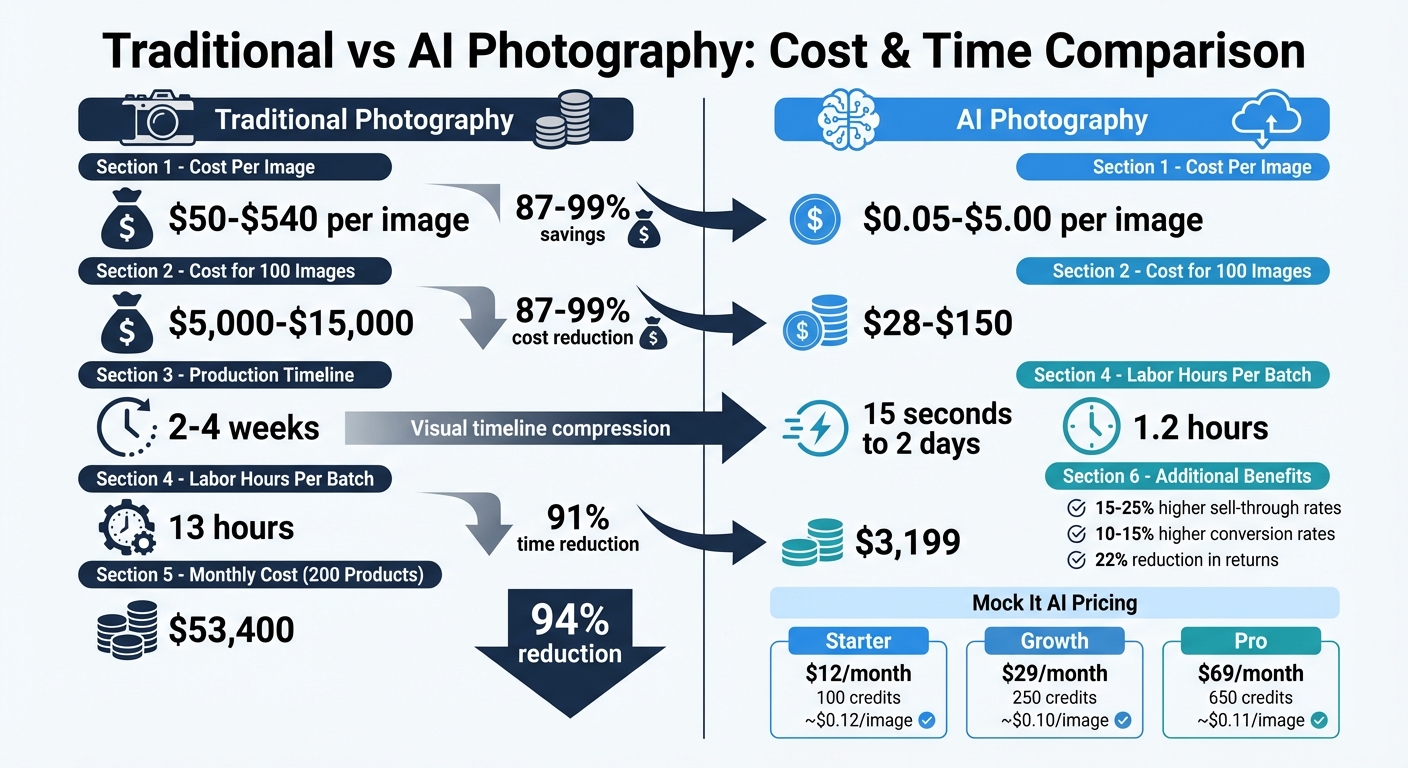
Traditional vs AI Photography Costs: Side-by-Side Comparison
Cost Comparisons: Traditional vs. AI
Traditional photography can cost anywhere from $50 to $540 per image, factoring in expenses like photographer fees, studio rentals, models, retouching, shipping, and coordination. In contrast, AI solutions slash this cost to $0.05 to $5.00 per image, depending on the subscription plan and volume.
Let’s break it down: creating 100 images with traditional photography costs between $5,000 and $15,000, while AI reduces that to just $28 to $150 – a staggering 87% to 99% cost reduction. Businesses using AI are gaining a clear financial edge, producing images for mere pennies while competitors pay significantly more.
Take LuxStyle, for example – a fashion retailer managing a catalog of 2,000 products. Their annual photography budget of $680,000 (involving 12 photographers and a 6-week production timeline) dropped to just $85,000 after adopting AI. That’s an 87.5% savings. On top of that, production time shrank to 2 days, while customer engagement rose by 34%, and conversion rates increased by 28%.
Time Efficiency Gains
AI doesn’t just save money – it saves time. Production timelines that traditionally take 2 to 4 weeks can now be completed in as little as 15 seconds to 2 days. Labor requirements per batch are slashed from 13 hours to just 1.2 hours, representing a 91% reduction in time spent.
These speed improvements directly influence profitability. Brands that can list products 2 to 3 weeks earlier capture peak demand, leading to 15% to 25% higher sell-through rates. Even quality review times see dramatic reductions – from 15–30 minutes per product to just 1–2 minutes. This frees up staff to focus on more strategic tasks, further boosting efficiency and ROI.
Return on Investment (ROI) Analysis
The combination of lower costs and faster production translates into massive ROI gains. For instance, a mid-size brand handling 200 products per month would spend $53,400 using traditional methods. With AI, that drops to just $3,199 – a 94% reduction. Similarly, small brands managing 50 products per month see costs plummet from $9,400 to $249, a 97% savings.
Mock It AI’s pricing makes these savings achievable for businesses of all sizes:
Starter Plan: $12/month for 100 image generations (~$0.12 per image)
Growth Plan: $29/month for 250 image generations (~$0.12 per image)
Pro Plan: $69/month for 650 image generations (~$0.11 per image)
Compare this to the $84 per image cost of traditional methods, and the difference is clear.
AI also enhances e-commerce performance. Brands using consistent, AI-generated imagery report 10% to 15% higher page-to-cart conversion rates. Additionally, they reduce the 22% of returns caused by products looking different from their online images. Together, these benefits – lower costs, quicker time-to-market, improved conversions, and fewer returns – help businesses strengthen their bottom line.
Mock It AI operates on a credit-based system, where one credit equals one image generation. It offers three subscription tiers tailored to different production needs. The Starter Plan is priced at $12 per month and provides 100 credits. The Growth Plan costs $29 monthly, offering 250 credits (approximately $0.10 per image). For those with higher demands, the Pro Plan includes 650 credits for $69 per month. There’s no daily generation cap, so you can create as many images as your credits allow. Plus, if you run out of credits mid-project, you can upgrade your plan instantly to keep things moving.
Cost and Scalability Comparison Table
Plan
Monthly Price
Credits
Cost Per Image
Best For
Starter
$12
100
~$0.12
Small brands and individual designers testing AI workflows
Growth
$29
250
~$0.10
Growing brands with frequent product releases
Pro
$69
650
~$0.11
Large batch campaigns, agencies, and high-volume catalogs
Traditional Photography
N/A
N/A
A few hundred dollars per shoot
Studio shoots with models, photographers, and post-production
The cost savings are clear. For instance, Robert H. shared:
“I was about to do a small photoshoot last fall. It was going to cost a few hundred dollars… I’m a very happy customer with a few hundred extra dollars in my pocket”.
Similarly, Sarah M. explained:
“I run a tiny clothing brand and I do everything myself… Mock It AI lets me bang out decent product pics in an hour and keep moving”.
Transitioning to AI-Driven Batch Photography
Once you’ve seen the cost advantages, transitioning to AI-powered batch photography is straightforward. Mock It AI simplifies the process into four steps, taking less than a minute per image.
Build a digital model: Customize attributes like gender, age, ethnicity, hairstyle, pose, and expression.
Dress the model: Select from various clothing styles, colors, and fits, including t-shirts, hoodies, jeans, and more.
Set the scene: Choose or describe a background to match your desired aesthetic.
Upload your design: The platform’s 3D mapping technology automatically adjusts your artwork to fit fabric textures, folds, and wrinkles, creating realistic visuals.
To ensure consistency and inspiration, start with the AI Moodboard Generator. This tool helps you compile visual references aligned with your brand. Then, use the Prompt Builder to fine-tune your image generation process. For optimal results, select formats that fit your platform’s specifications.
Tyler K. highlighted the platform’s flexibility, saying:
“I can make images that don’t look homemade, and I can redo them if I change my mind without starting from scratch”.
This streamlined approach transforms traditional expenses into predictable subscription costs, while saving time and effort. With over 6,000 fashion designers and brands already on board, Mock It AI delivers high-quality mockups in under 30 seconds. If you hit your credit limit during a large campaign, simply upgrade your plan to maintain productivity.
Conclusion
AI-driven batch photography is reshaping how brands approach imagery, offering a cost-effective and time-saving alternative to traditional methods. While conventional photoshoots often come with hidden expenses, AI reduces these to just cents per image, slashing production timelines from weeks to mere minutes. This speed allows brands to act quickly, seizing market opportunities without delay.
The savings go beyond just dollars. With the resources freed up, brands can reinvest in growth. Take Luna & Sage, for example – they cut their photography budget by 80%, expanded their asset library tenfold, and saw a 28% jump in conversion rates. These numbers highlight how AI can revolutionize workflows and enhance results.
Mock It AI makes adopting this technology straightforward with subscription plans starting at $12 for 100 credits and going up to $69 for 650 credits. Forget about studio rentals, model fees, or shipping samples. Instead, you can customize everything – models, styles, settings – and generate professional-quality images in under a minute.
If you’re still relying on traditional photoshoots for batch photography, you’re likely spending more time and money than necessary. Over 6,000 fashion designers and clothing brands have already embraced this technology, proving its effectiveness. AI isn’t just changing product photography – it’s a shift you can’t afford to ignore. Sticking to outdated methods could leave your brand lagging behind.
FAQs
What do I need to start using AI for product photos?
To create product photos using AI, you’ll need an AI platform capable of generating high-quality images. Mock It AI is one example. It lets you create custom mockups by building a model, selecting clothing, describing locations, and uploading designs – perfect for clothing brands looking for tailored visuals.
You’ll also need to prepare clear product details, provide descriptions of the images you want, and choose a subscription or payment plan that matches the number of images you plan to generate.
Will AI images match my brand style across all SKUs?
AI-generated images can be customized to reflect your brand’s style consistently across all SKUs. By applying uniform visual settings and style parameters, you can maintain a cohesive look that aligns perfectly with your branding in every image.
How do I ensure AI photos look accurate to the real product?
To make sure AI-generated photos truly represent the actual product, double-check that the colors, shapes, and details are consistent with the real item. Accuracy is key because AI can sometimes tweak or alter certain aspects unintentionally. One way to achieve this is by using digital twin technology. These are exact digital replicas of your products, which can help maintain precision and consistency. This approach ensures the photos closely match the real product while minimizing potential errors.
AI is transforming the way brands handle product photography, slashing costs and saving time. Here’s the key takeaway: Switching to AI-powered photography can reduce costs by up to 99% and cut production time from weeks to minutes.
Key Points:
Cost Savings: Traditional photography costs $50–$540 per image. With AI, it’s just $0.05–$5.00 per image.
Time Efficiency: AI cuts production timelines from 2–4 weeks to as little as 15 seconds.
Improved ROI: Brands report up to 87% cost reductions and 15–25% higher sell-through rates.
Subscription Pricing: Plans start at $12/month for 100 images, making it affordable for businesses of all sizes.
Eliminates Hidden Costs: No need for studio rentals, models, shipping, or retouching teams.
AI tools like Mock It AI allow brands to create high-quality images quickly and affordably, offering a smarter way to scale without breaking the bank.
Traditional Batch Brand Photography Costs Explained
Traditional photography often comes with hidden expenses that can significantly inflate the initial price tag. It’s important to understand these costs to fully grasp how AI can help reduce them. The per-image rate you see in a quote typically accounts for only about half of the actual expenses. As Magic Blog puts it, the quoted price is just the “tip of the iceberg”.
Studio and Equipment Expenses
Studio-related costs form a major part of traditional photography budgets, even before a single photo is taken. Renting a studio can cost anywhere from $200 to $3,000 per day, depending on the location and included equipment. In cities like New York and Los Angeles, those rates often sit between $500 and $3,000. For brands needing studio space for 10 days a month, this adds up to $5,000 to $30,000 in monthly expenses.
Building an in-house studio doesn’t eliminate these costs – it just shifts them. Setting up a studio, complete with lighting and backdrops, requires an initial investment of $15,000 to $100,000. On top of that, a professional camera kit can cost between $5,000 and $20,000, while a high-quality lighting setup adds another $3,000 to $15,000.
Model, Photographer, and Labor Costs
Traditional shoots often require a full team, and the associated daily rates can quickly add up. Professional photographers typically charge between $500 and $3,000 per day. Hiring models costs $200 to $2,000 per day, with agencies tacking on an additional 20% to 25% fee. Other crew members, such as stylists ($300–$1,500 daily), hair and makeup artists ($200–$1,000 daily), and photo assistants ($200–$500 daily), further increase costs.
Here’s an example cost breakdown for a single-day shoot:
Expense Category
Estimated Cost
Photographer & Equipment
$1,000
Model
$500
Hair & Makeup
$250
Studio Rental
$600
Post-production
$300
Miscellaneous/Shipping
$100
Total (approx. 60 images)
$2,750
This works out to around $46 per image – and that’s before factoring in retouching, coordination, or reshoots.
Time and Post-Production Costs
Post-production is where expenses can quietly balloon. Retouching a single image takes 15 to 30 minutes, with editing fees ranging from $15 to $75 per image. For luxury brands, high-end retouching can cost anywhere from $60 to $180 per image. Overall, post-production and retouching can account for 20% to 50% of the total cost of a shoot.
Internal coordination adds another layer of expense. Tasks like briefing, scheduling, and reviewing proofs can consume 10 to 40 hours of staff time for each shoot. Shipping samples to the studio adds further costs, typically ranging from $50 to $200 or more per shipment. And if something goes wrong – like styling mistakes or lighting issues – about 15% to 20% of shoots require partial reshoots, effectively doubling the cost of those specific items. Rush fees and expedited delivery can also increase the overall cost by 25% to 200%.
These expenses highlight why traditional photography can be so costly and frame the potential savings that AI-driven workflows aim to deliver. Breaking down these cost drivers makes it clear where efficiencies can be found.
How AI Reduces Batch Photography Costs
AI is reshaping the economics of brand photography by decoupling the photo capture process from the creative process. Instead of organizing a separate photoshoot for every product variation, brands can now take a single foundational image and use AI to create numerous variations from it. This shift moves photography from a linear cost structure – where more products mean higher expenses – to a subscription-based model where the cost of additional images becomes negligible. This approach significantly lowers labor costs, reduces overhead, and speeds up production.
For instance, traditional photography for a mid-sized brand with 500 SKUs typically costs between $125,000 and $250,000 annually. With AI-powered workflows, this expense can drop to as little as $600 to $1,200 – a reduction of up to 90%. Take Luna & Sage, a sustainable home goods brand, as an example. By switching to an AI-driven workflow in 2023, they slashed their annual photography budget from $42,000 to $8,400. Co-founder Maya Chen shared:
“We’d launch a new candle collection and by the time we got the photos back, our competitors had already captured the market moment. We were spending more on photos than on inventory”.
Automated Processes
AI tools streamline the editing process, processing up to 1,000 photos per minute. This drastically reduces the usual 15–30 minutes and $15–$75 cost per image. On average, editing time decreases by 80%, cutting batch processing from 13 hours to about 1.2 hours.
Platforms like Mock It AI simplify the entire process. Users can create virtual models, select clothing, describe locations, and upload designs to produce unique mockups instantly. This eliminates the need for a full production team, saving time and resources. For example, Sarah Chen, who launched a sustainable fashion startup with 45 pieces, was initially quoted $35,000 to $40,000 for a traditional lifestyle shoot. By using AI, she completed the project for under $500 in just two days instead of three weeks – and experienced a 23% increase in conversion rates.
Instant Customization for Branding
AI not only enhances efficiency but also ensures consistency across a brand’s catalog. It maintains uniform lighting, camera angles, and styling for thousands of SKUs, avoiding the inconsistencies that arise when different photographers or sessions handle various products. Allen Seavert, founder of SetupBots, explained:
“The architecture is the strategy. By shifting the bulk of the creative work from the physical world to the generative world, you change the economics of your entire offer”.
Customization becomes effortless and cost-effective. With platforms like Mock It AI, brands can create diverse model representations, swap backgrounds, and produce seasonal variations from a single base image. Subscription plans start at $12 per month for 100 image generations. In contrast, traditional photography would require separate shoots for each variation, leading to additional costs for talent and production. For example, TechFlow, an electronics accessories brand, used AI to create 200 localized assets from just 15 original images for a launch across 12 markets, saving an estimated $180,000 in localization expenses.
Eliminating Physical Resource Dependencies
AI eliminates the need for physical infrastructure, such as studio rentals ($1,500–$3,000 per day), camera equipment ($5,000–$20,000), and lighting setups ($3,000–$15,000). The production crew – photographers, models, hair and makeup artists, and stylists – typically costing $1,500 to $7,000 per shoot, is replaced by AI-driven virtual generation.
Logistics costs also vanish. Shipping physical samples to studios, which can cost $50 to $200 per round trip, often adds up to $1,000 to $5,000 monthly for brands handling 200 products. Traditional timelines of 10 to 21 days – from shipping to final images – shrink to under an hour with AI, enabling faster time-to-market and boosting sell-through rates by 15% to 25%.
Cost and Time Savings with AI: The Numbers
Traditional vs AI Photography Costs: Side-by-Side Comparison
Cost Comparisons: Traditional vs. AI
Traditional photography can cost anywhere from $50 to $540 per image, factoring in expenses like photographer fees, studio rentals, models, retouching, shipping, and coordination. In contrast, AI solutions slash this cost to $0.05 to $5.00 per image, depending on the subscription plan and volume.
Let’s break it down: creating 100 images with traditional photography costs between $5,000 and $15,000, while AI reduces that to just $28 to $150 – a staggering 87% to 99% cost reduction. Businesses using AI are gaining a clear financial edge, producing images for mere pennies while competitors pay significantly more.
Take LuxStyle, for example – a fashion retailer managing a catalog of 2,000 products. Their annual photography budget of $680,000 (involving 12 photographers and a 6-week production timeline) dropped to just $85,000 after adopting AI. That’s an 87.5% savings. On top of that, production time shrank to 2 days, while customer engagement rose by 34%, and conversion rates increased by 28%.
Time Efficiency Gains
AI doesn’t just save money – it saves time. Production timelines that traditionally take 2 to 4 weeks can now be completed in as little as 15 seconds to 2 days. Labor requirements per batch are slashed from 13 hours to just 1.2 hours, representing a 91% reduction in time spent.
These speed improvements directly influence profitability. Brands that can list products 2 to 3 weeks earlier capture peak demand, leading to 15% to 25% higher sell-through rates. Even quality review times see dramatic reductions – from 15–30 minutes per product to just 1–2 minutes. This frees up staff to focus on more strategic tasks, further boosting efficiency and ROI.
Return on Investment (ROI) Analysis
The combination of lower costs and faster production translates into massive ROI gains. For instance, a mid-size brand handling 200 products per month would spend $53,400 using traditional methods. With AI, that drops to just $3,199 – a 94% reduction. Similarly, small brands managing 50 products per month see costs plummet from $9,400 to $249, a 97% savings.
Mock It AI’s pricing makes these savings achievable for businesses of all sizes:
Starter Plan: $12/month for 100 image generations (~$0.12 per image)
Growth Plan: $29/month for 250 image generations (~$0.12 per image)
Pro Plan: $69/month for 650 image generations (~$0.11 per image)
Compare this to the $84 per image cost of traditional methods, and the difference is clear.
AI also enhances e-commerce performance. Brands using consistent, AI-generated imagery report 10% to 15% higher page-to-cart conversion rates. Additionally, they reduce the 22% of returns caused by products looking different from their online images. Together, these benefits – lower costs, quicker time-to-market, improved conversions, and fewer returns – help businesses strengthen their bottom line.
Mock It AI operates on a credit-based system, where one credit equals one image generation. It offers three subscription tiers tailored to different production needs. The Starter Plan is priced at $12 per month and provides 100 credits. The Growth Plan costs $29 monthly, offering 250 credits (approximately $0.10 per image). For those with higher demands, the Pro Plan includes 650 credits for $69 per month. There’s no daily generation cap, so you can create as many images as your credits allow. Plus, if you run out of credits mid-project, you can upgrade your plan instantly to keep things moving.
Cost and Scalability Comparison Table
Plan
Monthly Price
Credits
Cost Per Image
Best For
Starter
$12
100
~$0.12
Small brands and individual designers testing AI workflows
Growth
$29
250
~$0.10
Growing brands with frequent product releases
Pro
$69
650
~$0.11
Large batch campaigns, agencies, and high-volume catalogs
Traditional Photography
N/A
N/A
A few hundred dollars per shoot
Studio shoots with models, photographers, and post-production
The cost savings are clear. For instance, Robert H. shared:
“I was about to do a small photoshoot last fall. It was going to cost a few hundred dollars… I’m a very happy customer with a few hundred extra dollars in my pocket”.
Similarly, Sarah M. explained:
“I run a tiny clothing brand and I do everything myself… Mock It AI lets me bang out decent product pics in an hour and keep moving”.
Transitioning to AI-Driven Batch Photography
Once you’ve seen the cost advantages, transitioning to AI-powered batch photography is straightforward. Mock It AI simplifies the process into four steps, taking less than a minute per image.
Build a digital model: Customize attributes like gender, age, ethnicity, hairstyle, pose, and expression.
Dress the model: Select from various clothing styles, colors, and fits, including t-shirts, hoodies, jeans, and more.
Set the scene: Choose or describe a background to match your desired aesthetic.
Upload your design: The platform’s 3D mapping technology automatically adjusts your artwork to fit fabric textures, folds, and wrinkles, creating realistic visuals.
To ensure consistency and inspiration, start with the AI Moodboard Generator. This tool helps you compile visual references aligned with your brand. Then, use the Prompt Builder to fine-tune your image generation process. For optimal results, select formats that fit your platform’s specifications.
Tyler K. highlighted the platform’s flexibility, saying:
“I can make images that don’t look homemade, and I can redo them if I change my mind without starting from scratch”.
This streamlined approach transforms traditional expenses into predictable subscription costs, while saving time and effort. With over 6,000 fashion designers and brands already on board, Mock It AI delivers high-quality mockups in under 30 seconds. If you hit your credit limit during a large campaign, simply upgrade your plan to maintain productivity.
Conclusion
AI-driven batch photography is reshaping how brands approach imagery, offering a cost-effective and time-saving alternative to traditional methods. While conventional photoshoots often come with hidden expenses, AI reduces these to just cents per image, slashing production timelines from weeks to mere minutes. This speed allows brands to act quickly, seizing market opportunities without delay.
The savings go beyond just dollars. With the resources freed up, brands can reinvest in growth. Take Luna & Sage, for example – they cut their photography budget by 80%, expanded their asset library tenfold, and saw a 28% jump in conversion rates. These numbers highlight how AI can revolutionize workflows and enhance results.
Mock It AI makes adopting this technology straightforward with subscription plans starting at $12 for 100 credits and going up to $69 for 650 credits. Forget about studio rentals, model fees, or shipping samples. Instead, you can customize everything – models, styles, settings – and generate professional-quality images in under a minute.
If you’re still relying on traditional photoshoots for batch photography, you’re likely spending more time and money than necessary. Over 6,000 fashion designers and clothing brands have already embraced this technology, proving its effectiveness. AI isn’t just changing product photography – it’s a shift you can’t afford to ignore. Sticking to outdated methods could leave your brand lagging behind.
FAQs
What do I need to start using AI for product photos?
To create product photos using AI, you’ll need an AI platform capable of generating high-quality images. Mock It AI is one example. It lets you create custom mockups by building a model, selecting clothing, describing locations, and uploading designs – perfect for clothing brands looking for tailored visuals.
You’ll also need to prepare clear product details, provide descriptions of the images you want, and choose a subscription or payment plan that matches the number of images you plan to generate.
Will AI images match my brand style across all SKUs?
AI-generated images can be customized to reflect your brand’s style consistently across all SKUs. By applying uniform visual settings and style parameters, you can maintain a cohesive look that aligns perfectly with your branding in every image.
How do I ensure AI photos look accurate to the real product?
To make sure AI-generated photos truly represent the actual product, double-check that the colors, shapes, and details are consistent with the real item. Accuracy is key because AI can sometimes tweak or alter certain aspects unintentionally. One way to achieve this is by using digital twin technology. These are exact digital replicas of your products, which can help maintain precision and consistency. This approach ensures the photos closely match the real product while minimizing potential errors.
Jeremy P is the Founder and Owner of Mock It AI, Mock It, and Pixel Sauce. With years of experience, Jeremy has assisted thousands of brands, designers, and individuals in creating high-quality product images and mockups for their businesses and clients. A pioneer and leader in the apparel mockup space, Jeremy is dedicated to finding innovative ways to help brands and designers enhance their visual content. His expertise and forward-thinking approach make him a prominent figure in the industry.
AI is transforming the way brands handle product photography, slashing costs and saving time. Here’s the key takeaway: Switching to AI-powered photography can reduce costs by up to 99% and cut production time from weeks to minutes.
Key Points:
Cost Savings: Traditional photography costs $50–$540 per image. With AI, it’s just $0.05–$5.00 per image.
Time Efficiency: AI cuts production timelines from 2–4 weeks to as little as 15 seconds.
Improved ROI: Brands report up to 87% cost reductions and 15–25% higher sell-through rates.
Subscription Pricing: Plans start at $12/month for 100 images, making it affordable for businesses of all sizes.
Eliminates Hidden Costs: No need for studio rentals, models, shipping, or retouching teams.
AI tools like Mock It AI allow brands to create high-quality images quickly and affordably, offering a smarter way to scale without breaking the bank.
Traditional Batch Brand Photography Costs Explained
Traditional photography often comes with hidden expenses that can significantly inflate the initial price tag. It’s important to understand these costs to fully grasp how AI can help reduce them. The per-image rate you see in a quote typically accounts for only about half of the actual expenses. As Magic Blog puts it, the quoted price is just the “tip of the iceberg”.
Studio and Equipment Expenses
Studio-related costs form a major part of traditional photography budgets, even before a single photo is taken. Renting a studio can cost anywhere from $200 to $3,000 per day, depending on the location and included equipment. In cities like New York and Los Angeles, those rates often sit between $500 and $3,000. For brands needing studio space for 10 days a month, this adds up to $5,000 to $30,000 in monthly expenses.
Building an in-house studio doesn’t eliminate these costs – it just shifts them. Setting up a studio, complete with lighting and backdrops, requires an initial investment of $15,000 to $100,000. On top of that, a professional camera kit can cost between $5,000 and $20,000, while a high-quality lighting setup adds another $3,000 to $15,000.
Model, Photographer, and Labor Costs
Traditional shoots often require a full team, and the associated daily rates can quickly add up. Professional photographers typically charge between $500 and $3,000 per day. Hiring models costs $200 to $2,000 per day, with agencies tacking on an additional 20% to 25% fee. Other crew members, such as stylists ($300–$1,500 daily), hair and makeup artists ($200–$1,000 daily), and photo assistants ($200–$500 daily), further increase costs.
Here’s an example cost breakdown for a single-day shoot:
Expense Category
Estimated Cost
Photographer & Equipment
$1,000
Model
$500
Hair & Makeup
$250
Studio Rental
$600
Post-production
$300
Miscellaneous/Shipping
$100
Total (approx. 60 images)
$2,750
This works out to around $46 per image – and that’s before factoring in retouching, coordination, or reshoots.
Time and Post-Production Costs
Post-production is where expenses can quietly balloon. Retouching a single image takes 15 to 30 minutes, with editing fees ranging from $15 to $75 per image. For luxury brands, high-end retouching can cost anywhere from $60 to $180 per image. Overall, post-production and retouching can account for 20% to 50% of the total cost of a shoot.
Internal coordination adds another layer of expense. Tasks like briefing, scheduling, and reviewing proofs can consume 10 to 40 hours of staff time for each shoot. Shipping samples to the studio adds further costs, typically ranging from $50 to $200 or more per shipment. And if something goes wrong – like styling mistakes or lighting issues – about 15% to 20% of shoots require partial reshoots, effectively doubling the cost of those specific items. Rush fees and expedited delivery can also increase the overall cost by 25% to 200%.
These expenses highlight why traditional photography can be so costly and frame the potential savings that AI-driven workflows aim to deliver. Breaking down these cost drivers makes it clear where efficiencies can be found.
How AI Reduces Batch Photography Costs
AI is reshaping the economics of brand photography by decoupling the photo capture process from the creative process. Instead of organizing a separate photoshoot for every product variation, brands can now take a single foundational image and use AI to create numerous variations from it. This shift moves photography from a linear cost structure – where more products mean higher expenses – to a subscription-based model where the cost of additional images becomes negligible. This approach significantly lowers labor costs, reduces overhead, and speeds up production.
For instance, traditional photography for a mid-sized brand with 500 SKUs typically costs between $125,000 and $250,000 annually. With AI-powered workflows, this expense can drop to as little as $600 to $1,200 – a reduction of up to 90%. Take Luna & Sage, a sustainable home goods brand, as an example. By switching to an AI-driven workflow in 2023, they slashed their annual photography budget from $42,000 to $8,400. Co-founder Maya Chen shared:
“We’d launch a new candle collection and by the time we got the photos back, our competitors had already captured the market moment. We were spending more on photos than on inventory”.
Automated Processes
AI tools streamline the editing process, processing up to 1,000 photos per minute. This drastically reduces the usual 15–30 minutes and $15–$75 cost per image. On average, editing time decreases by 80%, cutting batch processing from 13 hours to about 1.2 hours.
Platforms like Mock It AI simplify the entire process. Users can create virtual models, select clothing, describe locations, and upload designs to produce unique mockups instantly. This eliminates the need for a full production team, saving time and resources. For example, Sarah Chen, who launched a sustainable fashion startup with 45 pieces, was initially quoted $35,000 to $40,000 for a traditional lifestyle shoot. By using AI, she completed the project for under $500 in just two days instead of three weeks – and experienced a 23% increase in conversion rates.
Instant Customization for Branding
AI not only enhances efficiency but also ensures consistency across a brand’s catalog. It maintains uniform lighting, camera angles, and styling for thousands of SKUs, avoiding the inconsistencies that arise when different photographers or sessions handle various products. Allen Seavert, founder of SetupBots, explained:
“The architecture is the strategy. By shifting the bulk of the creative work from the physical world to the generative world, you change the economics of your entire offer”.
Customization becomes effortless and cost-effective. With platforms like Mock It AI, brands can create diverse model representations, swap backgrounds, and produce seasonal variations from a single base image. Subscription plans start at $12 per month for 100 image generations. In contrast, traditional photography would require separate shoots for each variation, leading to additional costs for talent and production. For example, TechFlow, an electronics accessories brand, used AI to create 200 localized assets from just 15 original images for a launch across 12 markets, saving an estimated $180,000 in localization expenses.
Eliminating Physical Resource Dependencies
AI eliminates the need for physical infrastructure, such as studio rentals ($1,500–$3,000 per day), camera equipment ($5,000–$20,000), and lighting setups ($3,000–$15,000). The production crew – photographers, models, hair and makeup artists, and stylists – typically costing $1,500 to $7,000 per shoot, is replaced by AI-driven virtual generation.
Logistics costs also vanish. Shipping physical samples to studios, which can cost $50 to $200 per round trip, often adds up to $1,000 to $5,000 monthly for brands handling 200 products. Traditional timelines of 10 to 21 days – from shipping to final images – shrink to under an hour with AI, enabling faster time-to-market and boosting sell-through rates by 15% to 25%.
Cost and Time Savings with AI: The Numbers
Traditional vs AI Photography Costs: Side-by-Side Comparison
Cost Comparisons: Traditional vs. AI
Traditional photography can cost anywhere from $50 to $540 per image, factoring in expenses like photographer fees, studio rentals, models, retouching, shipping, and coordination. In contrast, AI solutions slash this cost to $0.05 to $5.00 per image, depending on the subscription plan and volume.
Let’s break it down: creating 100 images with traditional photography costs between $5,000 and $15,000, while AI reduces that to just $28 to $150 – a staggering 87% to 99% cost reduction. Businesses using AI are gaining a clear financial edge, producing images for mere pennies while competitors pay significantly more.
Take LuxStyle, for example – a fashion retailer managing a catalog of 2,000 products. Their annual photography budget of $680,000 (involving 12 photographers and a 6-week production timeline) dropped to just $85,000 after adopting AI. That’s an 87.5% savings. On top of that, production time shrank to 2 days, while customer engagement rose by 34%, and conversion rates increased by 28%.
Time Efficiency Gains
AI doesn’t just save money – it saves time. Production timelines that traditionally take 2 to 4 weeks can now be completed in as little as 15 seconds to 2 days. Labor requirements per batch are slashed from 13 hours to just 1.2 hours, representing a 91% reduction in time spent.
These speed improvements directly influence profitability. Brands that can list products 2 to 3 weeks earlier capture peak demand, leading to 15% to 25% higher sell-through rates. Even quality review times see dramatic reductions – from 15–30 minutes per product to just 1–2 minutes. This frees up staff to focus on more strategic tasks, further boosting efficiency and ROI.
Return on Investment (ROI) Analysis
The combination of lower costs and faster production translates into massive ROI gains. For instance, a mid-size brand handling 200 products per month would spend $53,400 using traditional methods. With AI, that drops to just $3,199 – a 94% reduction. Similarly, small brands managing 50 products per month see costs plummet from $9,400 to $249, a 97% savings.
Mock It AI’s pricing makes these savings achievable for businesses of all sizes:
Starter Plan: $12/month for 100 image generations (~$0.12 per image)
Growth Plan: $29/month for 250 image generations (~$0.12 per image)
Pro Plan: $69/month for 650 image generations (~$0.11 per image)
Compare this to the $84 per image cost of traditional methods, and the difference is clear.
AI also enhances e-commerce performance. Brands using consistent, AI-generated imagery report 10% to 15% higher page-to-cart conversion rates. Additionally, they reduce the 22% of returns caused by products looking different from their online images. Together, these benefits – lower costs, quicker time-to-market, improved conversions, and fewer returns – help businesses strengthen their bottom line.
Mock It AI operates on a credit-based system, where one credit equals one image generation. It offers three subscription tiers tailored to different production needs. The Starter Plan is priced at $12 per month and provides 100 credits. The Growth Plan costs $29 monthly, offering 250 credits (approximately $0.10 per image). For those with higher demands, the Pro Plan includes 650 credits for $69 per month. There’s no daily generation cap, so you can create as many images as your credits allow. Plus, if you run out of credits mid-project, you can upgrade your plan instantly to keep things moving.
Cost and Scalability Comparison Table
Plan
Monthly Price
Credits
Cost Per Image
Best For
Starter
$12
100
~$0.12
Small brands and individual designers testing AI workflows
Growth
$29
250
~$0.10
Growing brands with frequent product releases
Pro
$69
650
~$0.11
Large batch campaigns, agencies, and high-volume catalogs
Traditional Photography
N/A
N/A
A few hundred dollars per shoot
Studio shoots with models, photographers, and post-production
The cost savings are clear. For instance, Robert H. shared:
“I was about to do a small photoshoot last fall. It was going to cost a few hundred dollars… I’m a very happy customer with a few hundred extra dollars in my pocket”.
Similarly, Sarah M. explained:
“I run a tiny clothing brand and I do everything myself… Mock It AI lets me bang out decent product pics in an hour and keep moving”.
Transitioning to AI-Driven Batch Photography
Once you’ve seen the cost advantages, transitioning to AI-powered batch photography is straightforward. Mock It AI simplifies the process into four steps, taking less than a minute per image.
Build a digital model: Customize attributes like gender, age, ethnicity, hairstyle, pose, and expression.
Dress the model: Select from various clothing styles, colors, and fits, including t-shirts, hoodies, jeans, and more.
Set the scene: Choose or describe a background to match your desired aesthetic.
Upload your design: The platform’s 3D mapping technology automatically adjusts your artwork to fit fabric textures, folds, and wrinkles, creating realistic visuals.
To ensure consistency and inspiration, start with the AI Moodboard Generator. This tool helps you compile visual references aligned with your brand. Then, use the Prompt Builder to fine-tune your image generation process. For optimal results, select formats that fit your platform’s specifications.
Tyler K. highlighted the platform’s flexibility, saying:
“I can make images that don’t look homemade, and I can redo them if I change my mind without starting from scratch”.
This streamlined approach transforms traditional expenses into predictable subscription costs, while saving time and effort. With over 6,000 fashion designers and brands already on board, Mock It AI delivers high-quality mockups in under 30 seconds. If you hit your credit limit during a large campaign, simply upgrade your plan to maintain productivity.
Conclusion
AI-driven batch photography is reshaping how brands approach imagery, offering a cost-effective and time-saving alternative to traditional methods. While conventional photoshoots often come with hidden expenses, AI reduces these to just cents per image, slashing production timelines from weeks to mere minutes. This speed allows brands to act quickly, seizing market opportunities without delay.
The savings go beyond just dollars. With the resources freed up, brands can reinvest in growth. Take Luna & Sage, for example – they cut their photography budget by 80%, expanded their asset library tenfold, and saw a 28% jump in conversion rates. These numbers highlight how AI can revolutionize workflows and enhance results.
Mock It AI makes adopting this technology straightforward with subscription plans starting at $12 for 100 credits and going up to $69 for 650 credits. Forget about studio rentals, model fees, or shipping samples. Instead, you can customize everything – models, styles, settings – and generate professional-quality images in under a minute.
If you’re still relying on traditional photoshoots for batch photography, you’re likely spending more time and money than necessary. Over 6,000 fashion designers and clothing brands have already embraced this technology, proving its effectiveness. AI isn’t just changing product photography – it’s a shift you can’t afford to ignore. Sticking to outdated methods could leave your brand lagging behind.
FAQs
What do I need to start using AI for product photos?
To create product photos using AI, you’ll need an AI platform capable of generating high-quality images. Mock It AI is one example. It lets you create custom mockups by building a model, selecting clothing, describing locations, and uploading designs – perfect for clothing brands looking for tailored visuals.
You’ll also need to prepare clear product details, provide descriptions of the images you want, and choose a subscription or payment plan that matches the number of images you plan to generate.
Will AI images match my brand style across all SKUs?
AI-generated images can be customized to reflect your brand’s style consistently across all SKUs. By applying uniform visual settings and style parameters, you can maintain a cohesive look that aligns perfectly with your branding in every image.
How do I ensure AI photos look accurate to the real product?
To make sure AI-generated photos truly represent the actual product, double-check that the colors, shapes, and details are consistent with the real item. Accuracy is key because AI can sometimes tweak or alter certain aspects unintentionally. One way to achieve this is by using digital twin technology. These are exact digital replicas of your products, which can help maintain precision and consistency. This approach ensures the photos closely match the real product while minimizing potential errors.
AI is transforming the way brands handle product photography, slashing costs and saving time. Here’s the key takeaway: Switching to AI-powered photography can reduce costs by up to 99% and cut production time from weeks to minutes.
Key Points:
Cost Savings: Traditional photography costs $50–$540 per image. With AI, it’s just $0.05–$5.00 per image.
Time Efficiency: AI cuts production timelines from 2–4 weeks to as little as 15 seconds.
Improved ROI: Brands report up to 87% cost reductions and 15–25% higher sell-through rates.
Subscription Pricing: Plans start at $12/month for 100 images, making it affordable for businesses of all sizes.
Eliminates Hidden Costs: No need for studio rentals, models, shipping, or retouching teams.
AI tools like Mock It AI allow brands to create high-quality images quickly and affordably, offering a smarter way to scale without breaking the bank.
Traditional Batch Brand Photography Costs Explained
Traditional photography often comes with hidden expenses that can significantly inflate the initial price tag. It’s important to understand these costs to fully grasp how AI can help reduce them. The per-image rate you see in a quote typically accounts for only about half of the actual expenses. As Magic Blog puts it, the quoted price is just the “tip of the iceberg”.
Studio and Equipment Expenses
Studio-related costs form a major part of traditional photography budgets, even before a single photo is taken. Renting a studio can cost anywhere from $200 to $3,000 per day, depending on the location and included equipment. In cities like New York and Los Angeles, those rates often sit between $500 and $3,000. For brands needing studio space for 10 days a month, this adds up to $5,000 to $30,000 in monthly expenses.
Building an in-house studio doesn’t eliminate these costs – it just shifts them. Setting up a studio, complete with lighting and backdrops, requires an initial investment of $15,000 to $100,000. On top of that, a professional camera kit can cost between $5,000 and $20,000, while a high-quality lighting setup adds another $3,000 to $15,000.
Model, Photographer, and Labor Costs
Traditional shoots often require a full team, and the associated daily rates can quickly add up. Professional photographers typically charge between $500 and $3,000 per day. Hiring models costs $200 to $2,000 per day, with agencies tacking on an additional 20% to 25% fee. Other crew members, such as stylists ($300–$1,500 daily), hair and makeup artists ($200–$1,000 daily), and photo assistants ($200–$500 daily), further increase costs.
Here’s an example cost breakdown for a single-day shoot:
Expense Category
Estimated Cost
Photographer & Equipment
$1,000
Model
$500
Hair & Makeup
$250
Studio Rental
$600
Post-production
$300
Miscellaneous/Shipping
$100
Total (approx. 60 images)
$2,750
This works out to around $46 per image – and that’s before factoring in retouching, coordination, or reshoots.
Time and Post-Production Costs
Post-production is where expenses can quietly balloon. Retouching a single image takes 15 to 30 minutes, with editing fees ranging from $15 to $75 per image. For luxury brands, high-end retouching can cost anywhere from $60 to $180 per image. Overall, post-production and retouching can account for 20% to 50% of the total cost of a shoot.
Internal coordination adds another layer of expense. Tasks like briefing, scheduling, and reviewing proofs can consume 10 to 40 hours of staff time for each shoot. Shipping samples to the studio adds further costs, typically ranging from $50 to $200 or more per shipment. And if something goes wrong – like styling mistakes or lighting issues – about 15% to 20% of shoots require partial reshoots, effectively doubling the cost of those specific items. Rush fees and expedited delivery can also increase the overall cost by 25% to 200%.
These expenses highlight why traditional photography can be so costly and frame the potential savings that AI-driven workflows aim to deliver. Breaking down these cost drivers makes it clear where efficiencies can be found.
How AI Reduces Batch Photography Costs
AI is reshaping the economics of brand photography by decoupling the photo capture process from the creative process. Instead of organizing a separate photoshoot for every product variation, brands can now take a single foundational image and use AI to create numerous variations from it. This shift moves photography from a linear cost structure – where more products mean higher expenses – to a subscription-based model where the cost of additional images becomes negligible. This approach significantly lowers labor costs, reduces overhead, and speeds up production.
For instance, traditional photography for a mid-sized brand with 500 SKUs typically costs between $125,000 and $250,000 annually. With AI-powered workflows, this expense can drop to as little as $600 to $1,200 – a reduction of up to 90%. Take Luna & Sage, a sustainable home goods brand, as an example. By switching to an AI-driven workflow in 2023, they slashed their annual photography budget from $42,000 to $8,400. Co-founder Maya Chen shared:
“We’d launch a new candle collection and by the time we got the photos back, our competitors had already captured the market moment. We were spending more on photos than on inventory”.
Automated Processes
AI tools streamline the editing process, processing up to 1,000 photos per minute. This drastically reduces the usual 15–30 minutes and $15–$75 cost per image. On average, editing time decreases by 80%, cutting batch processing from 13 hours to about 1.2 hours.
Platforms like Mock It AI simplify the entire process. Users can create virtual models, select clothing, describe locations, and upload designs to produce unique mockups instantly. This eliminates the need for a full production team, saving time and resources. For example, Sarah Chen, who launched a sustainable fashion startup with 45 pieces, was initially quoted $35,000 to $40,000 for a traditional lifestyle shoot. By using AI, she completed the project for under $500 in just two days instead of three weeks – and experienced a 23% increase in conversion rates.
Instant Customization for Branding
AI not only enhances efficiency but also ensures consistency across a brand’s catalog. It maintains uniform lighting, camera angles, and styling for thousands of SKUs, avoiding the inconsistencies that arise when different photographers or sessions handle various products. Allen Seavert, founder of SetupBots, explained:
“The architecture is the strategy. By shifting the bulk of the creative work from the physical world to the generative world, you change the economics of your entire offer”.
Customization becomes effortless and cost-effective. With platforms like Mock It AI, brands can create diverse model representations, swap backgrounds, and produce seasonal variations from a single base image. Subscription plans start at $12 per month for 100 image generations. In contrast, traditional photography would require separate shoots for each variation, leading to additional costs for talent and production. For example, TechFlow, an electronics accessories brand, used AI to create 200 localized assets from just 15 original images for a launch across 12 markets, saving an estimated $180,000 in localization expenses.
Eliminating Physical Resource Dependencies
AI eliminates the need for physical infrastructure, such as studio rentals ($1,500–$3,000 per day), camera equipment ($5,000–$20,000), and lighting setups ($3,000–$15,000). The production crew – photographers, models, hair and makeup artists, and stylists – typically costing $1,500 to $7,000 per shoot, is replaced by AI-driven virtual generation.
Logistics costs also vanish. Shipping physical samples to studios, which can cost $50 to $200 per round trip, often adds up to $1,000 to $5,000 monthly for brands handling 200 products. Traditional timelines of 10 to 21 days – from shipping to final images – shrink to under an hour with AI, enabling faster time-to-market and boosting sell-through rates by 15% to 25%.
Cost and Time Savings with AI: The Numbers
Traditional vs AI Photography Costs: Side-by-Side Comparison
Cost Comparisons: Traditional vs. AI
Traditional photography can cost anywhere from $50 to $540 per image, factoring in expenses like photographer fees, studio rentals, models, retouching, shipping, and coordination. In contrast, AI solutions slash this cost to $0.05 to $5.00 per image, depending on the subscription plan and volume.
Let’s break it down: creating 100 images with traditional photography costs between $5,000 and $15,000, while AI reduces that to just $28 to $150 – a staggering 87% to 99% cost reduction. Businesses using AI are gaining a clear financial edge, producing images for mere pennies while competitors pay significantly more.
Take LuxStyle, for example – a fashion retailer managing a catalog of 2,000 products. Their annual photography budget of $680,000 (involving 12 photographers and a 6-week production timeline) dropped to just $85,000 after adopting AI. That’s an 87.5% savings. On top of that, production time shrank to 2 days, while customer engagement rose by 34%, and conversion rates increased by 28%.
Time Efficiency Gains
AI doesn’t just save money – it saves time. Production timelines that traditionally take 2 to 4 weeks can now be completed in as little as 15 seconds to 2 days. Labor requirements per batch are slashed from 13 hours to just 1.2 hours, representing a 91% reduction in time spent.
These speed improvements directly influence profitability. Brands that can list products 2 to 3 weeks earlier capture peak demand, leading to 15% to 25% higher sell-through rates. Even quality review times see dramatic reductions – from 15–30 minutes per product to just 1–2 minutes. This frees up staff to focus on more strategic tasks, further boosting efficiency and ROI.
Return on Investment (ROI) Analysis
The combination of lower costs and faster production translates into massive ROI gains. For instance, a mid-size brand handling 200 products per month would spend $53,400 using traditional methods. With AI, that drops to just $3,199 – a 94% reduction. Similarly, small brands managing 50 products per month see costs plummet from $9,400 to $249, a 97% savings.
Mock It AI’s pricing makes these savings achievable for businesses of all sizes:
Starter Plan: $12/month for 100 image generations (~$0.12 per image)
Growth Plan: $29/month for 250 image generations (~$0.12 per image)
Pro Plan: $69/month for 650 image generations (~$0.11 per image)
Compare this to the $84 per image cost of traditional methods, and the difference is clear.
AI also enhances e-commerce performance. Brands using consistent, AI-generated imagery report 10% to 15% higher page-to-cart conversion rates. Additionally, they reduce the 22% of returns caused by products looking different from their online images. Together, these benefits – lower costs, quicker time-to-market, improved conversions, and fewer returns – help businesses strengthen their bottom line.
Mock It AI operates on a credit-based system, where one credit equals one image generation. It offers three subscription tiers tailored to different production needs. The Starter Plan is priced at $12 per month and provides 100 credits. The Growth Plan costs $29 monthly, offering 250 credits (approximately $0.10 per image). For those with higher demands, the Pro Plan includes 650 credits for $69 per month. There’s no daily generation cap, so you can create as many images as your credits allow. Plus, if you run out of credits mid-project, you can upgrade your plan instantly to keep things moving.
Cost and Scalability Comparison Table
Plan
Monthly Price
Credits
Cost Per Image
Best For
Starter
$12
100
~$0.12
Small brands and individual designers testing AI workflows
Growth
$29
250
~$0.10
Growing brands with frequent product releases
Pro
$69
650
~$0.11
Large batch campaigns, agencies, and high-volume catalogs
Traditional Photography
N/A
N/A
A few hundred dollars per shoot
Studio shoots with models, photographers, and post-production
The cost savings are clear. For instance, Robert H. shared:
“I was about to do a small photoshoot last fall. It was going to cost a few hundred dollars… I’m a very happy customer with a few hundred extra dollars in my pocket”.
Similarly, Sarah M. explained:
“I run a tiny clothing brand and I do everything myself… Mock It AI lets me bang out decent product pics in an hour and keep moving”.
Transitioning to AI-Driven Batch Photography
Once you’ve seen the cost advantages, transitioning to AI-powered batch photography is straightforward. Mock It AI simplifies the process into four steps, taking less than a minute per image.
Build a digital model: Customize attributes like gender, age, ethnicity, hairstyle, pose, and expression.
Dress the model: Select from various clothing styles, colors, and fits, including t-shirts, hoodies, jeans, and more.
Set the scene: Choose or describe a background to match your desired aesthetic.
Upload your design: The platform’s 3D mapping technology automatically adjusts your artwork to fit fabric textures, folds, and wrinkles, creating realistic visuals.
To ensure consistency and inspiration, start with the AI Moodboard Generator. This tool helps you compile visual references aligned with your brand. Then, use the Prompt Builder to fine-tune your image generation process. For optimal results, select formats that fit your platform’s specifications.
Tyler K. highlighted the platform’s flexibility, saying:
“I can make images that don’t look homemade, and I can redo them if I change my mind without starting from scratch”.
This streamlined approach transforms traditional expenses into predictable subscription costs, while saving time and effort. With over 6,000 fashion designers and brands already on board, Mock It AI delivers high-quality mockups in under 30 seconds. If you hit your credit limit during a large campaign, simply upgrade your plan to maintain productivity.
Conclusion
AI-driven batch photography is reshaping how brands approach imagery, offering a cost-effective and time-saving alternative to traditional methods. While conventional photoshoots often come with hidden expenses, AI reduces these to just cents per image, slashing production timelines from weeks to mere minutes. This speed allows brands to act quickly, seizing market opportunities without delay.
The savings go beyond just dollars. With the resources freed up, brands can reinvest in growth. Take Luna & Sage, for example – they cut their photography budget by 80%, expanded their asset library tenfold, and saw a 28% jump in conversion rates. These numbers highlight how AI can revolutionize workflows and enhance results.
Mock It AI makes adopting this technology straightforward with subscription plans starting at $12 for 100 credits and going up to $69 for 650 credits. Forget about studio rentals, model fees, or shipping samples. Instead, you can customize everything – models, styles, settings – and generate professional-quality images in under a minute.
If you’re still relying on traditional photoshoots for batch photography, you’re likely spending more time and money than necessary. Over 6,000 fashion designers and clothing brands have already embraced this technology, proving its effectiveness. AI isn’t just changing product photography – it’s a shift you can’t afford to ignore. Sticking to outdated methods could leave your brand lagging behind.
FAQs
What do I need to start using AI for product photos?
To create product photos using AI, you’ll need an AI platform capable of generating high-quality images. Mock It AI is one example. It lets you create custom mockups by building a model, selecting clothing, describing locations, and uploading designs – perfect for clothing brands looking for tailored visuals.
You’ll also need to prepare clear product details, provide descriptions of the images you want, and choose a subscription or payment plan that matches the number of images you plan to generate.
Will AI images match my brand style across all SKUs?
AI-generated images can be customized to reflect your brand’s style consistently across all SKUs. By applying uniform visual settings and style parameters, you can maintain a cohesive look that aligns perfectly with your branding in every image.
How do I ensure AI photos look accurate to the real product?
To make sure AI-generated photos truly represent the actual product, double-check that the colors, shapes, and details are consistent with the real item. Accuracy is key because AI can sometimes tweak or alter certain aspects unintentionally. One way to achieve this is by using digital twin technology. These are exact digital replicas of your products, which can help maintain precision and consistency. This approach ensures the photos closely match the real product while minimizing potential errors.
Jeremy P is the Founder and Owner of Mock It AI, Mock It, and Pixel Sauce. With years of experience, Jeremy has assisted thousands of brands, designers, and individuals in creating high-quality product images and mockups for their businesses and clients. A pioneer and leader in the apparel mockup space, Jeremy is dedicated to finding innovative ways to help brands and designers enhance their visual content. His expertise and forward-thinking approach make him a prominent figure in the industry.