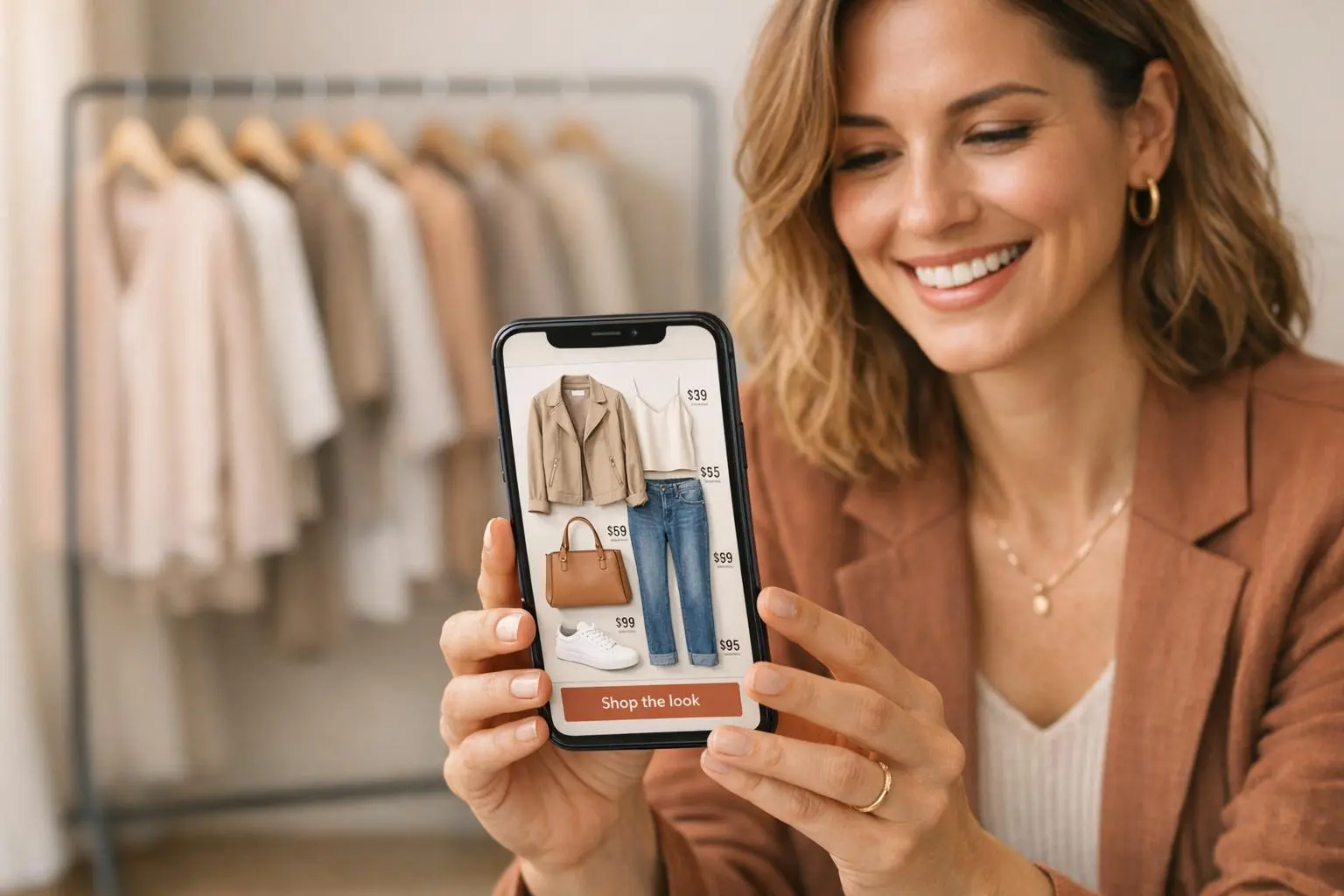
AI outfit suggestions are reshaping online fashion retail by helping shoppers visualize complete looks instead of browsing isolated items. This technology combines product data, user behavior, and contextual signals like weather to recommend personalized, shoppable ensembles. The result? Enhanced shopping experiences, higher conversion rates, and fewer returns.
Here’s how it works:
Data-driven insights: AI analyzes product catalogs, purchase history, and live inventory to create tailored outfits.
Personalized recommendations: Suggestions are based on factors like body type, location, and occasion.
Improved engagement: Tools like “Complete the Look” modules boost time spent on sites and increase order sizes by 15%-25%.
Reduced returns: Accurate styling builds shopper confidence, cutting return rates by up to 20%.
AI styling tools are easy to integrate with platforms like Shopify and WooCommerce and can be enhanced with visuals from tools like Mock It AI. This approach saves time, reduces decision fatigue, and makes online shopping feel more intuitive.
Customer Challenges in Outfit Discovery
Shoppers often don’t struggle to find individual pieces – they struggle to put together complete, wearable outfits. This disconnect between liking a single item and imagining an entire look can cost brands sales. AI-powered styling tools aim to bridge this gap, making outfit discovery easier and more intuitive.
Fragmented Shopping Experience
Ecommerce platforms typically showcase items in isolation. A shopper might browse a blouse, trousers, or a jacket, but there’s no clear way to see how these pieces work together. The burden of creating a cohesive outfit falls entirely on the customer.
This mental effort can quickly become overwhelming. For example, if a shopper has 50 tops and 50 bottoms to choose from, there are 2,500 possible combinations. That’s a lot of decisions to make, and this uncertainty often leads to decision fatigue, abandoned carts, or missed sales opportunities.
To make matters worse, traditional recommendation engines don’t help much. These tools often suggest similar items – like another blue blouse or a different pair of slim-fit pants – rather than showing how to create a full outfit. This approach can leave shoppers feeling stuck and uninspired.
Low Confidence in Fit and Style
Even when shoppers find items they like, doubts about fit and style often creep in. Will these pieces look good together? Are they right for the occasion? Will the fabric drape the same way on me as it does on the model?
This hesitation, sometimes called “model body shock”, is a major hurdle. If shoppers can’t picture themselves in the outfit, they’re likely to abandon their carts or return their purchases. In fact, fashion return rates hit 24.4% in 2023. A big driver of these returns is uncertainty about whether the items are styled appropriately for the customer’s needs or body type. Addressing these concerns is key to reducing returns and building trust.
Lack of Personalization
Many shopping experiences cater to a generic audience, failing to account for personal factors like climate, regional trends, body shape, or budget.
Take, for example, a shopper in Miami searching for “fall outfits.” Their needs will differ significantly from someone in Minneapolis. Similarly, someone shopping for a “work outfit” at a creative agency will likely dress differently than someone preparing for a corporate boardroom. When these nuances are ignored, recommendations can feel irrelevant – and irrelevant suggestions erode trust. Today, 71% of shoppers expect personalized recommendations. Brands that can’t meet this expectation risk losing not just a sale but also customer loyalty.
These challenges underline why AI-powered solutions are becoming essential for transforming the online shopping experience, making it easier and more personalized for every customer.
sbb-itb-2c1a147
How AI Outfit Suggestions Work
AI tackles the challenge of fragmented outfit discovery by combining diverse data inputs and advanced algorithms to create cohesive, shoppable looks. These systems don’t just recommend individual items – they curate complete ensembles tailored to the shopper’s preferences and context.
Core Data Inputs
AI outfit recommendation systems rely on three primary data sources:
Product catalog: This includes details like SKUs, colors, silhouettes, fabric types, price points, and inventory levels.
Shopper behavior: Data like clicks, scroll depth, past purchases, and cart additions provide insights into customer preferences.
Contextual signals: Factors such as local weather, geographic location, seasonality, and occasion-specific cues add an extra layer of relevance.
Data is gathered both explicitly (through style quizzes, wishlists, and size profiles) and implicitly (via engagement metrics like page visits and purchase history). Together, these inputs allow the AI to build a detailed understanding of each shopper’s style over time.
For new users, systems rely on immediate contextual data – like location and current weather – to make recommendations while behavioral data is still being collected. This approach helps address the “cold start” problem.
Once the data is in place, tailored algorithms take over to match styles effectively.
AI Algorithms for Style Matching
Unlike traditional systems that focus on finding similar items, AI outfit generators use co-occurrence logic. This means they analyze which items are frequently paired together in purchases or styled lookbooks.
“Fashion shopping is rarely about ‘finding another similar item.’ Shoppers are inspired by context and guided by style.” – Anuraag Verma, Content Strategist, Algonomy
The algorithms blend collaborative filtering with content-based filtering, enhanced by a styling layer. This layer ensures that outfits follow brand-specific rules, such as pairing structured pieces with relaxed ones or maintaining cohesive color palettes. Over time, some platforms even learn a brand’s creative identity, ensuring that outfit suggestions align with its aesthetic rather than appearing generic.
One critical factor is syncing the AI with live inventory data. Recommending items that are out of stock can lead to shopper frustration and lost sales.
These curated outfits are then strategically displayed to shoppers in ways that encourage engagement and purchases.
How Outfits Are Displayed to Shoppers
AI-generated outfits are showcased in various formats, such as “Complete the Look” modules on product pages, personalized homepage feeds, or at checkout. Each display method serves a specific purpose, whether it’s cross-selling, inspiring shoppers, or increasing transaction sizes.
Real-world examples highlight the effectiveness of this approach:
JD Sports uses a “Complete the Look” feature to pair sneakers with hoodies and accessories, all based on real-time stock levels and current streetwear trends.
Men’s Wearhouse offers an AI-powered “Get Styled” tool, which suggests full ensembles – suits, shirts, ties, and shoes – tailored to occasions like weddings or board meetings.
The way outfits are visually presented also matters. On-model imagery tends to outperform flat lays because it provides a more realistic view of how pieces interact when worn. Showing outfits from multiple angles – such as front, three-quarter, and lifestyle poses – further bridges the gap between browsing and buying.
Benefits of AI Outfit Suggestions for Clothing Brands
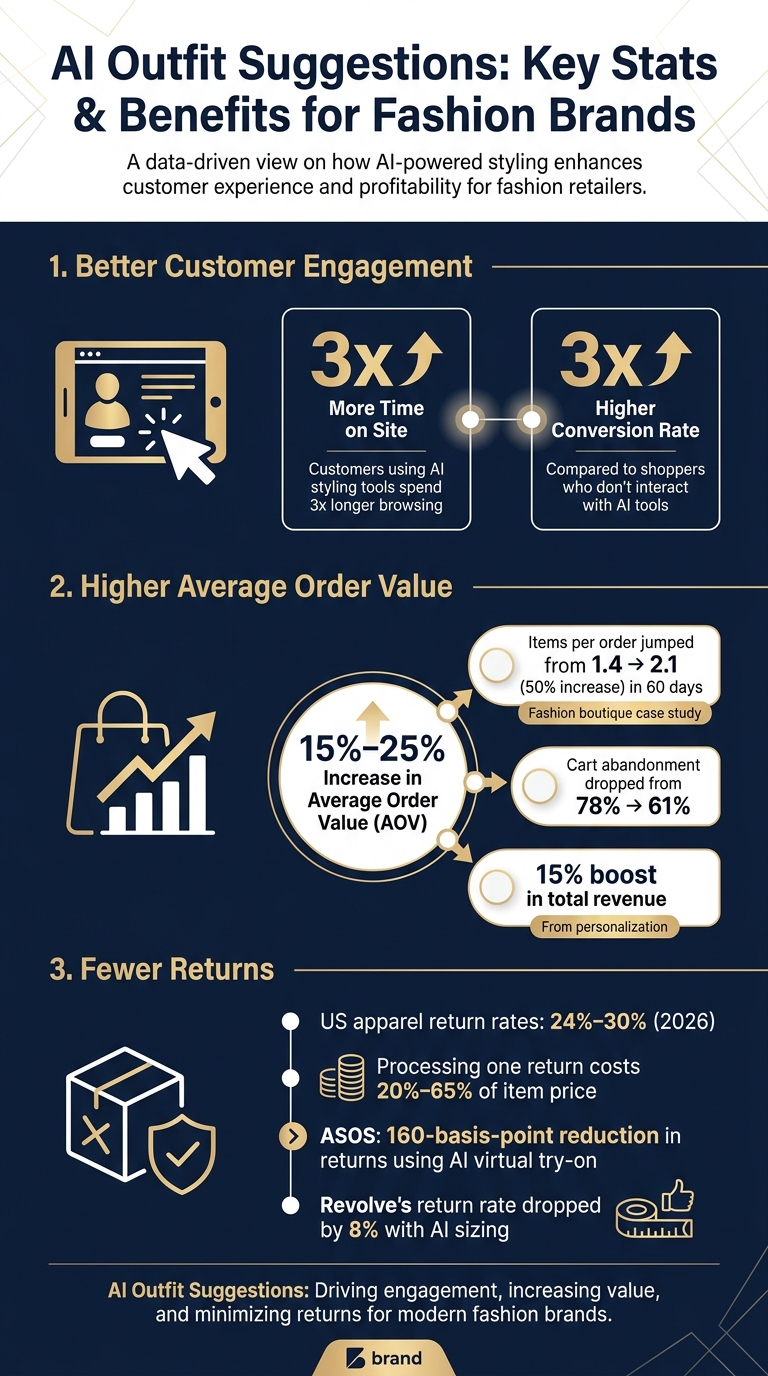
AI Outfit Suggestions: Key Stats & Benefits for Fashion Brands
AI has become a game-changer for clothing brands, offering practical solutions to challenges like fragmented shopping experiences, lack of confidence in styling, and the absence of personalization. By leveraging advanced matching and display capabilities, brands can create a more engaging and efficient shopping experience for their customers.
Better Customer Engagement
Shoppers visiting a product page often want more than just a single item – they want to see how it fits into a complete outfit. AI outfit suggestions make this possible by showcasing curated ensembles tailored to a customer’s style, location, and occasion. This approach eliminates the overwhelm of endless scrolling and decision fatigue, creating a more seamless shopping journey.
The results speak for themselves: customers who interact with AI styling tools spend 3x more time on the site and convert at 3x the rate compared to those who don’t.
Higher Average Order Value
AI doesn’t just enhance engagement – it also drives bigger purchases. Instead of suggesting similar items, AI recommends complementary pieces to create a full look. For example, instead of showing another pair of jeans, it might suggest a jacket, shoes, and a bag to complete the outfit, making it easy for shoppers to add everything to their cart.
This strategy has a direct impact on revenue. AI-powered styling tools have been shown to increase average order value (AOV) by 15% to 25%. One fashion boutique saw a dramatic shift after implementing an AI styling assistant: over a 60-day period, items per order jumped from 1.4 to 2.1 – a 50% increase – while cart abandonment rates dropped from 78% to 61%. On a broader scale, personalization in fashion retail can lead to a 15% boost in total revenue.
Fewer Returns
Returns are a costly issue for fashion retailers, with US apparel return rates ranging from 24% to 30% as of 2026. Processing a single return can cost a retailer between 20% and 65% of the original item’s price. AI outfit suggestions help mitigate this problem by giving shoppers confidence in their purchases. By showing how colors, proportions, and styles work together, shoppers can make more informed decisions before checking out.
Brands are already seeing the benefits. For example, ASOS reported a 160-basis-point reduction in its returns rate after using AI-powered virtual try-on technology in early 2026. Similarly, Revolve introduced its “Build a Look” feature in October 2025, which resulted in a double-digit drop in returns and a 3x increase in conversion rates.
“The fastest path to lower returns isn’t free shipping or lenient policies, but better confidence before checkout.” – Margo Waldrop, Content Writer, The Drum
AI also addresses the issue of “bracketing”, where shoppers buy multiple sizes or colors with the intention of returning most of them. This behavior, driven by uncertainty about fit, is practiced by 63% of shoppers. By providing accurate, contextual visuals of outfits styled for real-life occasions, AI helps customers make more deliberate and confident choices, reducing the likelihood of returns.
How to Add AI Outfit Suggestions to Your Workflow
Data and System Requirements
To make AI outfit suggestions work effectively, you need to start with a well-organized product catalog. At a minimum, this catalog should include detailed SKUs, categories, image URLs, color tags, material descriptions, and formality levels. These details form the backbone of the AI’s matching logic, so accuracy is crucial.
A real-time inventory feed is also essential. This ensures that recommendations only include items currently in stock, helping to avoid frustrating customer experiences.
The technology behind AI outfit suggestions typically involves vector databases like pgvector or Pinecone, which enable fast item matching, and large language models such as Gemini or Vertex AI, which interpret styling rules. If your catalog includes 500 or more SKUs, batch processing (via CSV uploads) can save time by generating outfit combinations for the entire inventory at once. Additionally, any customer data used for personalization – like clicks, skips, or add-to-cart actions – must be anonymized to comply with U.S. privacy regulations.
Connecting AI to Your Ecommerce Platform
Once your data is ready, the next step is deciding where to display these outfit suggestions. The most effective placements include:
Product Detail Pages (PDPs): Adding “Complete the Look” modules below the main product image can drive additional purchases.
Checkout Pages: Offering last-minute outfit suggestions here can boost average order value.
Homepages: Ideal for curated inspiration, especially for returning shoppers.
“AI bundling turns product discovery into outfit planning, presenting shoppers with styled, occasion-ready looks instead of category grids.” – Stylitics Marketing Team
Most AI outfit suggestion tools integrate easily with platforms like Shopify, WooCommerce, and Salesforce Commerce Cloud via APIs or SDKs. For example, a leading menswear retailer used AI to create a styled shopping experience that grouped products by real-life occasions, such as “Date Night” or “Business Formal.” This allowed customers to shop full outfits – suits, shoes, and accessories – in one seamless step.
With the integration in place, the next focus should be on creating visuals that bring these AI-generated outfit recommendations to life.
Visuals are key to making AI outfit suggestions impactful. Shoppers need more than just a list of items – they need to visually connect with the complete look. That’s where Mock It AI comes in.
Mock It AI allows brands to quickly create photorealistic, location-specific visuals without the need for physical photo shoots. By uploading your designs and describing the setting, you can generate mockups tailored to specific contexts. For instance, a U.S. swimwear brand might use a coastal backdrop for summer looks, while a fall collection could be set against a city street.
This tool is scalable for businesses of all sizes, with pricing plans designed to accommodate both small boutiques and larger catalogs. Once the visuals are ready, they can be seamlessly integrated into PDPs, email campaigns, and social media posts – ensuring every AI-driven recommendation is accompanied by an eye-catching, on-brand image.
Conclusion: What AI Outfit Suggestions Mean for Fashion Retail
AI outfit suggestions are transforming the way clothing brands connect with their customers. Instead of offering individual items, brands can now present complete, ready-to-wear looks tailored for specific occasions, making shopping easier and more appealing. According to McKinsey, personalization can boost revenues by 10–15%, while AI-powered recommendations have been shown to increase conversion rates by 30% in the fashion industry.
But it’s not just about better engagement – there’s a practical side to this, too. AI eliminates the need for manual merchandising by instantly creating styled outfit combinations from hundreds of SKUs. This means even smaller U.S. brands can compete with larger retailers, offering high-quality styling at a fraction of the cost.
“You don’t win shoppers over by throwing more SKUs at them. You win by showing them how to wear what you sell.” – Anuraag Verma, Algonomy
AI styling also addresses a major pain point: returns. By providing clear and cohesive visuals, shoppers feel more confident in their purchases, leading to a 15–20% reduction in return rates.
To tie it all together, strong visuals play a crucial role. Tools like Mock It AI enable U.S. brands to create photorealistic outfit images without the expense of traditional photoshoots. Starting at just $12/month, brands of any size can produce high-quality visuals that make AI-driven recommendations more impactful. This blend of AI and compelling imagery creates a shopping experience that feels personal, seamless, and intuitive for today’s fashion consumers.
FAQs
What data do I need to launch AI outfit suggestions?
To kick off AI-powered outfit suggestions, start by collecting essential data. This includes customer profiles – like body shape, style preferences, favorite colors, and purchase history – and detailed information about clothing items, such as images, categories, colors, patterns, and textures. Don’t forget to factor in contextual elements like current fashion trends, specific occasions, weather conditions, and regional style influences. This combination allows the AI to craft tailored, well-matched, and relevant outfit recommendations that align with individual tastes.
Where should I place “Complete the Look” on my store?
Placing a “Complete the Look” section close to product details or directly on product pages can make a big difference. It provides customers with outfit suggestions that pair well with the item they’re viewing. This not only helps them visualize how to style the product but also encourages them to add more items to their cart, increasing their average order value (AOV).
How can AI outfit suggestions reduce returns?
AI-powered outfit suggestions are making shopping smarter and more efficient. By improving product recommendations, refining sizing accuracy, and even offering virtual try-on options, these tools help customers pick items that align with their preferences and fit well. The result? Fewer mismatches, better satisfaction, and a noticeable drop in fit-related returns.
AI outfit suggestions are reshaping online fashion retail by helping shoppers visualize complete looks instead of browsing isolated items. This technology combines product data, user behavior, and contextual signals like weather to recommend personalized, shoppable ensembles. The result? Enhanced shopping experiences, higher conversion rates, and fewer returns.
Here’s how it works:
Data-driven insights: AI analyzes product catalogs, purchase history, and live inventory to create tailored outfits.
Personalized recommendations: Suggestions are based on factors like body type, location, and occasion.
Improved engagement: Tools like “Complete the Look” modules boost time spent on sites and increase order sizes by 15%-25%.
Reduced returns: Accurate styling builds shopper confidence, cutting return rates by up to 20%.
AI styling tools are easy to integrate with platforms like Shopify and WooCommerce and can be enhanced with visuals from tools like Mock It AI. This approach saves time, reduces decision fatigue, and makes online shopping feel more intuitive.
Customer Challenges in Outfit Discovery
Shoppers often don’t struggle to find individual pieces – they struggle to put together complete, wearable outfits. This disconnect between liking a single item and imagining an entire look can cost brands sales. AI-powered styling tools aim to bridge this gap, making outfit discovery easier and more intuitive.
Fragmented Shopping Experience
Ecommerce platforms typically showcase items in isolation. A shopper might browse a blouse, trousers, or a jacket, but there’s no clear way to see how these pieces work together. The burden of creating a cohesive outfit falls entirely on the customer.
This mental effort can quickly become overwhelming. For example, if a shopper has 50 tops and 50 bottoms to choose from, there are 2,500 possible combinations. That’s a lot of decisions to make, and this uncertainty often leads to decision fatigue, abandoned carts, or missed sales opportunities.
To make matters worse, traditional recommendation engines don’t help much. These tools often suggest similar items – like another blue blouse or a different pair of slim-fit pants – rather than showing how to create a full outfit. This approach can leave shoppers feeling stuck and uninspired.
Low Confidence in Fit and Style
Even when shoppers find items they like, doubts about fit and style often creep in. Will these pieces look good together? Are they right for the occasion? Will the fabric drape the same way on me as it does on the model?
This hesitation, sometimes called “model body shock”, is a major hurdle. If shoppers can’t picture themselves in the outfit, they’re likely to abandon their carts or return their purchases. In fact, fashion return rates hit 24.4% in 2023. A big driver of these returns is uncertainty about whether the items are styled appropriately for the customer’s needs or body type. Addressing these concerns is key to reducing returns and building trust.
Lack of Personalization
Many shopping experiences cater to a generic audience, failing to account for personal factors like climate, regional trends, body shape, or budget.
Take, for example, a shopper in Miami searching for “fall outfits.” Their needs will differ significantly from someone in Minneapolis. Similarly, someone shopping for a “work outfit” at a creative agency will likely dress differently than someone preparing for a corporate boardroom. When these nuances are ignored, recommendations can feel irrelevant – and irrelevant suggestions erode trust. Today, 71% of shoppers expect personalized recommendations. Brands that can’t meet this expectation risk losing not just a sale but also customer loyalty.
These challenges underline why AI-powered solutions are becoming essential for transforming the online shopping experience, making it easier and more personalized for every customer.
sbb-itb-2c1a147
How AI Outfit Suggestions Work
AI tackles the challenge of fragmented outfit discovery by combining diverse data inputs and advanced algorithms to create cohesive, shoppable looks. These systems don’t just recommend individual items – they curate complete ensembles tailored to the shopper’s preferences and context.
Core Data Inputs
AI outfit recommendation systems rely on three primary data sources:
Product catalog: This includes details like SKUs, colors, silhouettes, fabric types, price points, and inventory levels.
Shopper behavior: Data like clicks, scroll depth, past purchases, and cart additions provide insights into customer preferences.
Contextual signals: Factors such as local weather, geographic location, seasonality, and occasion-specific cues add an extra layer of relevance.
Data is gathered both explicitly (through style quizzes, wishlists, and size profiles) and implicitly (via engagement metrics like page visits and purchase history). Together, these inputs allow the AI to build a detailed understanding of each shopper’s style over time.
For new users, systems rely on immediate contextual data – like location and current weather – to make recommendations while behavioral data is still being collected. This approach helps address the “cold start” problem.
Once the data is in place, tailored algorithms take over to match styles effectively.
AI Algorithms for Style Matching
Unlike traditional systems that focus on finding similar items, AI outfit generators use co-occurrence logic. This means they analyze which items are frequently paired together in purchases or styled lookbooks.
“Fashion shopping is rarely about ‘finding another similar item.’ Shoppers are inspired by context and guided by style.” – Anuraag Verma, Content Strategist, Algonomy
The algorithms blend collaborative filtering with content-based filtering, enhanced by a styling layer. This layer ensures that outfits follow brand-specific rules, such as pairing structured pieces with relaxed ones or maintaining cohesive color palettes. Over time, some platforms even learn a brand’s creative identity, ensuring that outfit suggestions align with its aesthetic rather than appearing generic.
One critical factor is syncing the AI with live inventory data. Recommending items that are out of stock can lead to shopper frustration and lost sales.
These curated outfits are then strategically displayed to shoppers in ways that encourage engagement and purchases.
How Outfits Are Displayed to Shoppers
AI-generated outfits are showcased in various formats, such as “Complete the Look” modules on product pages, personalized homepage feeds, or at checkout. Each display method serves a specific purpose, whether it’s cross-selling, inspiring shoppers, or increasing transaction sizes.
Real-world examples highlight the effectiveness of this approach:
JD Sports uses a “Complete the Look” feature to pair sneakers with hoodies and accessories, all based on real-time stock levels and current streetwear trends.
Men’s Wearhouse offers an AI-powered “Get Styled” tool, which suggests full ensembles – suits, shirts, ties, and shoes – tailored to occasions like weddings or board meetings.
The way outfits are visually presented also matters. On-model imagery tends to outperform flat lays because it provides a more realistic view of how pieces interact when worn. Showing outfits from multiple angles – such as front, three-quarter, and lifestyle poses – further bridges the gap between browsing and buying.
Benefits of AI Outfit Suggestions for Clothing Brands
AI Outfit Suggestions: Key Stats & Benefits for Fashion Brands
AI has become a game-changer for clothing brands, offering practical solutions to challenges like fragmented shopping experiences, lack of confidence in styling, and the absence of personalization. By leveraging advanced matching and display capabilities, brands can create a more engaging and efficient shopping experience for their customers.
Better Customer Engagement
Shoppers visiting a product page often want more than just a single item – they want to see how it fits into a complete outfit. AI outfit suggestions make this possible by showcasing curated ensembles tailored to a customer’s style, location, and occasion. This approach eliminates the overwhelm of endless scrolling and decision fatigue, creating a more seamless shopping journey.
The results speak for themselves: customers who interact with AI styling tools spend 3x more time on the site and convert at 3x the rate compared to those who don’t.
Higher Average Order Value
AI doesn’t just enhance engagement – it also drives bigger purchases. Instead of suggesting similar items, AI recommends complementary pieces to create a full look. For example, instead of showing another pair of jeans, it might suggest a jacket, shoes, and a bag to complete the outfit, making it easy for shoppers to add everything to their cart.
This strategy has a direct impact on revenue. AI-powered styling tools have been shown to increase average order value (AOV) by 15% to 25%. One fashion boutique saw a dramatic shift after implementing an AI styling assistant: over a 60-day period, items per order jumped from 1.4 to 2.1 – a 50% increase – while cart abandonment rates dropped from 78% to 61%. On a broader scale, personalization in fashion retail can lead to a 15% boost in total revenue.
Fewer Returns
Returns are a costly issue for fashion retailers, with US apparel return rates ranging from 24% to 30% as of 2026. Processing a single return can cost a retailer between 20% and 65% of the original item’s price. AI outfit suggestions help mitigate this problem by giving shoppers confidence in their purchases. By showing how colors, proportions, and styles work together, shoppers can make more informed decisions before checking out.
Brands are already seeing the benefits. For example, ASOS reported a 160-basis-point reduction in its returns rate after using AI-powered virtual try-on technology in early 2026. Similarly, Revolve introduced its “Build a Look” feature in October 2025, which resulted in a double-digit drop in returns and a 3x increase in conversion rates.
“The fastest path to lower returns isn’t free shipping or lenient policies, but better confidence before checkout.” – Margo Waldrop, Content Writer, The Drum
AI also addresses the issue of “bracketing”, where shoppers buy multiple sizes or colors with the intention of returning most of them. This behavior, driven by uncertainty about fit, is practiced by 63% of shoppers. By providing accurate, contextual visuals of outfits styled for real-life occasions, AI helps customers make more deliberate and confident choices, reducing the likelihood of returns.
How to Add AI Outfit Suggestions to Your Workflow
Data and System Requirements
To make AI outfit suggestions work effectively, you need to start with a well-organized product catalog. At a minimum, this catalog should include detailed SKUs, categories, image URLs, color tags, material descriptions, and formality levels. These details form the backbone of the AI’s matching logic, so accuracy is crucial.
A real-time inventory feed is also essential. This ensures that recommendations only include items currently in stock, helping to avoid frustrating customer experiences.
The technology behind AI outfit suggestions typically involves vector databases like pgvector or Pinecone, which enable fast item matching, and large language models such as Gemini or Vertex AI, which interpret styling rules. If your catalog includes 500 or more SKUs, batch processing (via CSV uploads) can save time by generating outfit combinations for the entire inventory at once. Additionally, any customer data used for personalization – like clicks, skips, or add-to-cart actions – must be anonymized to comply with U.S. privacy regulations.
Connecting AI to Your Ecommerce Platform
Once your data is ready, the next step is deciding where to display these outfit suggestions. The most effective placements include:
Product Detail Pages (PDPs): Adding “Complete the Look” modules below the main product image can drive additional purchases.
Checkout Pages: Offering last-minute outfit suggestions here can boost average order value.
Homepages: Ideal for curated inspiration, especially for returning shoppers.
“AI bundling turns product discovery into outfit planning, presenting shoppers with styled, occasion-ready looks instead of category grids.” – Stylitics Marketing Team
Most AI outfit suggestion tools integrate easily with platforms like Shopify, WooCommerce, and Salesforce Commerce Cloud via APIs or SDKs. For example, a leading menswear retailer used AI to create a styled shopping experience that grouped products by real-life occasions, such as “Date Night” or “Business Formal.” This allowed customers to shop full outfits – suits, shoes, and accessories – in one seamless step.
With the integration in place, the next focus should be on creating visuals that bring these AI-generated outfit recommendations to life.
Visuals are key to making AI outfit suggestions impactful. Shoppers need more than just a list of items – they need to visually connect with the complete look. That’s where Mock It AI comes in.
Mock It AI allows brands to quickly create photorealistic, location-specific visuals without the need for physical photo shoots. By uploading your designs and describing the setting, you can generate mockups tailored to specific contexts. For instance, a U.S. swimwear brand might use a coastal backdrop for summer looks, while a fall collection could be set against a city street.
This tool is scalable for businesses of all sizes, with pricing plans designed to accommodate both small boutiques and larger catalogs. Once the visuals are ready, they can be seamlessly integrated into PDPs, email campaigns, and social media posts – ensuring every AI-driven recommendation is accompanied by an eye-catching, on-brand image.
Conclusion: What AI Outfit Suggestions Mean for Fashion Retail
AI outfit suggestions are transforming the way clothing brands connect with their customers. Instead of offering individual items, brands can now present complete, ready-to-wear looks tailored for specific occasions, making shopping easier and more appealing. According to McKinsey, personalization can boost revenues by 10–15%, while AI-powered recommendations have been shown to increase conversion rates by 30% in the fashion industry.
But it’s not just about better engagement – there’s a practical side to this, too. AI eliminates the need for manual merchandising by instantly creating styled outfit combinations from hundreds of SKUs. This means even smaller U.S. brands can compete with larger retailers, offering high-quality styling at a fraction of the cost.
“You don’t win shoppers over by throwing more SKUs at them. You win by showing them how to wear what you sell.” – Anuraag Verma, Algonomy
AI styling also addresses a major pain point: returns. By providing clear and cohesive visuals, shoppers feel more confident in their purchases, leading to a 15–20% reduction in return rates.
To tie it all together, strong visuals play a crucial role. Tools like Mock It AI enable U.S. brands to create photorealistic outfit images without the expense of traditional photoshoots. Starting at just $12/month, brands of any size can produce high-quality visuals that make AI-driven recommendations more impactful. This blend of AI and compelling imagery creates a shopping experience that feels personal, seamless, and intuitive for today’s fashion consumers.
FAQs
What data do I need to launch AI outfit suggestions?
To kick off AI-powered outfit suggestions, start by collecting essential data. This includes customer profiles – like body shape, style preferences, favorite colors, and purchase history – and detailed information about clothing items, such as images, categories, colors, patterns, and textures. Don’t forget to factor in contextual elements like current fashion trends, specific occasions, weather conditions, and regional style influences. This combination allows the AI to craft tailored, well-matched, and relevant outfit recommendations that align with individual tastes.
Where should I place “Complete the Look” on my store?
Placing a “Complete the Look” section close to product details or directly on product pages can make a big difference. It provides customers with outfit suggestions that pair well with the item they’re viewing. This not only helps them visualize how to style the product but also encourages them to add more items to their cart, increasing their average order value (AOV).
How can AI outfit suggestions reduce returns?
AI-powered outfit suggestions are making shopping smarter and more efficient. By improving product recommendations, refining sizing accuracy, and even offering virtual try-on options, these tools help customers pick items that align with their preferences and fit well. The result? Fewer mismatches, better satisfaction, and a noticeable drop in fit-related returns.
Jeremy P is the Founder and Owner of Mock It AI, Mock It, and Pixel Sauce. With years of experience, Jeremy has assisted thousands of brands, designers, and individuals in creating high-quality product images and mockups for their businesses and clients. A pioneer and leader in the apparel mockup space, Jeremy is dedicated to finding innovative ways to help brands and designers enhance their visual content. His expertise and forward-thinking approach make him a prominent figure in the industry.
AI outfit suggestions are reshaping online fashion retail by helping shoppers visualize complete looks instead of browsing isolated items. This technology combines product data, user behavior, and contextual signals like weather to recommend personalized, shoppable ensembles. The result? Enhanced shopping experiences, higher conversion rates, and fewer returns.
Here’s how it works:
Data-driven insights: AI analyzes product catalogs, purchase history, and live inventory to create tailored outfits.
Personalized recommendations: Suggestions are based on factors like body type, location, and occasion.
Improved engagement: Tools like “Complete the Look” modules boost time spent on sites and increase order sizes by 15%-25%.
Reduced returns: Accurate styling builds shopper confidence, cutting return rates by up to 20%.
AI styling tools are easy to integrate with platforms like Shopify and WooCommerce and can be enhanced with visuals from tools like Mock It AI. This approach saves time, reduces decision fatigue, and makes online shopping feel more intuitive.
Customer Challenges in Outfit Discovery
Shoppers often don’t struggle to find individual pieces – they struggle to put together complete, wearable outfits. This disconnect between liking a single item and imagining an entire look can cost brands sales. AI-powered styling tools aim to bridge this gap, making outfit discovery easier and more intuitive.
Fragmented Shopping Experience
Ecommerce platforms typically showcase items in isolation. A shopper might browse a blouse, trousers, or a jacket, but there’s no clear way to see how these pieces work together. The burden of creating a cohesive outfit falls entirely on the customer.
This mental effort can quickly become overwhelming. For example, if a shopper has 50 tops and 50 bottoms to choose from, there are 2,500 possible combinations. That’s a lot of decisions to make, and this uncertainty often leads to decision fatigue, abandoned carts, or missed sales opportunities.
To make matters worse, traditional recommendation engines don’t help much. These tools often suggest similar items – like another blue blouse or a different pair of slim-fit pants – rather than showing how to create a full outfit. This approach can leave shoppers feeling stuck and uninspired.
Low Confidence in Fit and Style
Even when shoppers find items they like, doubts about fit and style often creep in. Will these pieces look good together? Are they right for the occasion? Will the fabric drape the same way on me as it does on the model?
This hesitation, sometimes called “model body shock”, is a major hurdle. If shoppers can’t picture themselves in the outfit, they’re likely to abandon their carts or return their purchases. In fact, fashion return rates hit 24.4% in 2023. A big driver of these returns is uncertainty about whether the items are styled appropriately for the customer’s needs or body type. Addressing these concerns is key to reducing returns and building trust.
Lack of Personalization
Many shopping experiences cater to a generic audience, failing to account for personal factors like climate, regional trends, body shape, or budget.
Take, for example, a shopper in Miami searching for “fall outfits.” Their needs will differ significantly from someone in Minneapolis. Similarly, someone shopping for a “work outfit” at a creative agency will likely dress differently than someone preparing for a corporate boardroom. When these nuances are ignored, recommendations can feel irrelevant – and irrelevant suggestions erode trust. Today, 71% of shoppers expect personalized recommendations. Brands that can’t meet this expectation risk losing not just a sale but also customer loyalty.
These challenges underline why AI-powered solutions are becoming essential for transforming the online shopping experience, making it easier and more personalized for every customer.
sbb-itb-2c1a147
How AI Outfit Suggestions Work
AI tackles the challenge of fragmented outfit discovery by combining diverse data inputs and advanced algorithms to create cohesive, shoppable looks. These systems don’t just recommend individual items – they curate complete ensembles tailored to the shopper’s preferences and context.
Core Data Inputs
AI outfit recommendation systems rely on three primary data sources:
Product catalog: This includes details like SKUs, colors, silhouettes, fabric types, price points, and inventory levels.
Shopper behavior: Data like clicks, scroll depth, past purchases, and cart additions provide insights into customer preferences.
Contextual signals: Factors such as local weather, geographic location, seasonality, and occasion-specific cues add an extra layer of relevance.
Data is gathered both explicitly (through style quizzes, wishlists, and size profiles) and implicitly (via engagement metrics like page visits and purchase history). Together, these inputs allow the AI to build a detailed understanding of each shopper’s style over time.
For new users, systems rely on immediate contextual data – like location and current weather – to make recommendations while behavioral data is still being collected. This approach helps address the “cold start” problem.
Once the data is in place, tailored algorithms take over to match styles effectively.
AI Algorithms for Style Matching
Unlike traditional systems that focus on finding similar items, AI outfit generators use co-occurrence logic. This means they analyze which items are frequently paired together in purchases or styled lookbooks.
“Fashion shopping is rarely about ‘finding another similar item.’ Shoppers are inspired by context and guided by style.” – Anuraag Verma, Content Strategist, Algonomy
The algorithms blend collaborative filtering with content-based filtering, enhanced by a styling layer. This layer ensures that outfits follow brand-specific rules, such as pairing structured pieces with relaxed ones or maintaining cohesive color palettes. Over time, some platforms even learn a brand’s creative identity, ensuring that outfit suggestions align with its aesthetic rather than appearing generic.
One critical factor is syncing the AI with live inventory data. Recommending items that are out of stock can lead to shopper frustration and lost sales.
These curated outfits are then strategically displayed to shoppers in ways that encourage engagement and purchases.
How Outfits Are Displayed to Shoppers
AI-generated outfits are showcased in various formats, such as “Complete the Look” modules on product pages, personalized homepage feeds, or at checkout. Each display method serves a specific purpose, whether it’s cross-selling, inspiring shoppers, or increasing transaction sizes.
Real-world examples highlight the effectiveness of this approach:
JD Sports uses a “Complete the Look” feature to pair sneakers with hoodies and accessories, all based on real-time stock levels and current streetwear trends.
Men’s Wearhouse offers an AI-powered “Get Styled” tool, which suggests full ensembles – suits, shirts, ties, and shoes – tailored to occasions like weddings or board meetings.
The way outfits are visually presented also matters. On-model imagery tends to outperform flat lays because it provides a more realistic view of how pieces interact when worn. Showing outfits from multiple angles – such as front, three-quarter, and lifestyle poses – further bridges the gap between browsing and buying.
Benefits of AI Outfit Suggestions for Clothing Brands
AI Outfit Suggestions: Key Stats & Benefits for Fashion Brands
AI has become a game-changer for clothing brands, offering practical solutions to challenges like fragmented shopping experiences, lack of confidence in styling, and the absence of personalization. By leveraging advanced matching and display capabilities, brands can create a more engaging and efficient shopping experience for their customers.
Better Customer Engagement
Shoppers visiting a product page often want more than just a single item – they want to see how it fits into a complete outfit. AI outfit suggestions make this possible by showcasing curated ensembles tailored to a customer’s style, location, and occasion. This approach eliminates the overwhelm of endless scrolling and decision fatigue, creating a more seamless shopping journey.
The results speak for themselves: customers who interact with AI styling tools spend 3x more time on the site and convert at 3x the rate compared to those who don’t.
Higher Average Order Value
AI doesn’t just enhance engagement – it also drives bigger purchases. Instead of suggesting similar items, AI recommends complementary pieces to create a full look. For example, instead of showing another pair of jeans, it might suggest a jacket, shoes, and a bag to complete the outfit, making it easy for shoppers to add everything to their cart.
This strategy has a direct impact on revenue. AI-powered styling tools have been shown to increase average order value (AOV) by 15% to 25%. One fashion boutique saw a dramatic shift after implementing an AI styling assistant: over a 60-day period, items per order jumped from 1.4 to 2.1 – a 50% increase – while cart abandonment rates dropped from 78% to 61%. On a broader scale, personalization in fashion retail can lead to a 15% boost in total revenue.
Fewer Returns
Returns are a costly issue for fashion retailers, with US apparel return rates ranging from 24% to 30% as of 2026. Processing a single return can cost a retailer between 20% and 65% of the original item’s price. AI outfit suggestions help mitigate this problem by giving shoppers confidence in their purchases. By showing how colors, proportions, and styles work together, shoppers can make more informed decisions before checking out.
Brands are already seeing the benefits. For example, ASOS reported a 160-basis-point reduction in its returns rate after using AI-powered virtual try-on technology in early 2026. Similarly, Revolve introduced its “Build a Look” feature in October 2025, which resulted in a double-digit drop in returns and a 3x increase in conversion rates.
“The fastest path to lower returns isn’t free shipping or lenient policies, but better confidence before checkout.” – Margo Waldrop, Content Writer, The Drum
AI also addresses the issue of “bracketing”, where shoppers buy multiple sizes or colors with the intention of returning most of them. This behavior, driven by uncertainty about fit, is practiced by 63% of shoppers. By providing accurate, contextual visuals of outfits styled for real-life occasions, AI helps customers make more deliberate and confident choices, reducing the likelihood of returns.
How to Add AI Outfit Suggestions to Your Workflow
Data and System Requirements
To make AI outfit suggestions work effectively, you need to start with a well-organized product catalog. At a minimum, this catalog should include detailed SKUs, categories, image URLs, color tags, material descriptions, and formality levels. These details form the backbone of the AI’s matching logic, so accuracy is crucial.
A real-time inventory feed is also essential. This ensures that recommendations only include items currently in stock, helping to avoid frustrating customer experiences.
The technology behind AI outfit suggestions typically involves vector databases like pgvector or Pinecone, which enable fast item matching, and large language models such as Gemini or Vertex AI, which interpret styling rules. If your catalog includes 500 or more SKUs, batch processing (via CSV uploads) can save time by generating outfit combinations for the entire inventory at once. Additionally, any customer data used for personalization – like clicks, skips, or add-to-cart actions – must be anonymized to comply with U.S. privacy regulations.
Connecting AI to Your Ecommerce Platform
Once your data is ready, the next step is deciding where to display these outfit suggestions. The most effective placements include:
Product Detail Pages (PDPs): Adding “Complete the Look” modules below the main product image can drive additional purchases.
Checkout Pages: Offering last-minute outfit suggestions here can boost average order value.
Homepages: Ideal for curated inspiration, especially for returning shoppers.
“AI bundling turns product discovery into outfit planning, presenting shoppers with styled, occasion-ready looks instead of category grids.” – Stylitics Marketing Team
Most AI outfit suggestion tools integrate easily with platforms like Shopify, WooCommerce, and Salesforce Commerce Cloud via APIs or SDKs. For example, a leading menswear retailer used AI to create a styled shopping experience that grouped products by real-life occasions, such as “Date Night” or “Business Formal.” This allowed customers to shop full outfits – suits, shoes, and accessories – in one seamless step.
With the integration in place, the next focus should be on creating visuals that bring these AI-generated outfit recommendations to life.
Visuals are key to making AI outfit suggestions impactful. Shoppers need more than just a list of items – they need to visually connect with the complete look. That’s where Mock It AI comes in.
Mock It AI allows brands to quickly create photorealistic, location-specific visuals without the need for physical photo shoots. By uploading your designs and describing the setting, you can generate mockups tailored to specific contexts. For instance, a U.S. swimwear brand might use a coastal backdrop for summer looks, while a fall collection could be set against a city street.
This tool is scalable for businesses of all sizes, with pricing plans designed to accommodate both small boutiques and larger catalogs. Once the visuals are ready, they can be seamlessly integrated into PDPs, email campaigns, and social media posts – ensuring every AI-driven recommendation is accompanied by an eye-catching, on-brand image.
Conclusion: What AI Outfit Suggestions Mean for Fashion Retail
AI outfit suggestions are transforming the way clothing brands connect with their customers. Instead of offering individual items, brands can now present complete, ready-to-wear looks tailored for specific occasions, making shopping easier and more appealing. According to McKinsey, personalization can boost revenues by 10–15%, while AI-powered recommendations have been shown to increase conversion rates by 30% in the fashion industry.
But it’s not just about better engagement – there’s a practical side to this, too. AI eliminates the need for manual merchandising by instantly creating styled outfit combinations from hundreds of SKUs. This means even smaller U.S. brands can compete with larger retailers, offering high-quality styling at a fraction of the cost.
“You don’t win shoppers over by throwing more SKUs at them. You win by showing them how to wear what you sell.” – Anuraag Verma, Algonomy
AI styling also addresses a major pain point: returns. By providing clear and cohesive visuals, shoppers feel more confident in their purchases, leading to a 15–20% reduction in return rates.
To tie it all together, strong visuals play a crucial role. Tools like Mock It AI enable U.S. brands to create photorealistic outfit images without the expense of traditional photoshoots. Starting at just $12/month, brands of any size can produce high-quality visuals that make AI-driven recommendations more impactful. This blend of AI and compelling imagery creates a shopping experience that feels personal, seamless, and intuitive for today’s fashion consumers.
FAQs
What data do I need to launch AI outfit suggestions?
To kick off AI-powered outfit suggestions, start by collecting essential data. This includes customer profiles – like body shape, style preferences, favorite colors, and purchase history – and detailed information about clothing items, such as images, categories, colors, patterns, and textures. Don’t forget to factor in contextual elements like current fashion trends, specific occasions, weather conditions, and regional style influences. This combination allows the AI to craft tailored, well-matched, and relevant outfit recommendations that align with individual tastes.
Where should I place “Complete the Look” on my store?
Placing a “Complete the Look” section close to product details or directly on product pages can make a big difference. It provides customers with outfit suggestions that pair well with the item they’re viewing. This not only helps them visualize how to style the product but also encourages them to add more items to their cart, increasing their average order value (AOV).
How can AI outfit suggestions reduce returns?
AI-powered outfit suggestions are making shopping smarter and more efficient. By improving product recommendations, refining sizing accuracy, and even offering virtual try-on options, these tools help customers pick items that align with their preferences and fit well. The result? Fewer mismatches, better satisfaction, and a noticeable drop in fit-related returns.
AI outfit suggestions are reshaping online fashion retail by helping shoppers visualize complete looks instead of browsing isolated items. This technology combines product data, user behavior, and contextual signals like weather to recommend personalized, shoppable ensembles. The result? Enhanced shopping experiences, higher conversion rates, and fewer returns.
Here’s how it works:
Data-driven insights: AI analyzes product catalogs, purchase history, and live inventory to create tailored outfits.
Personalized recommendations: Suggestions are based on factors like body type, location, and occasion.
Improved engagement: Tools like “Complete the Look” modules boost time spent on sites and increase order sizes by 15%-25%.
Reduced returns: Accurate styling builds shopper confidence, cutting return rates by up to 20%.
AI styling tools are easy to integrate with platforms like Shopify and WooCommerce and can be enhanced with visuals from tools like Mock It AI. This approach saves time, reduces decision fatigue, and makes online shopping feel more intuitive.
Customer Challenges in Outfit Discovery
Shoppers often don’t struggle to find individual pieces – they struggle to put together complete, wearable outfits. This disconnect between liking a single item and imagining an entire look can cost brands sales. AI-powered styling tools aim to bridge this gap, making outfit discovery easier and more intuitive.
Fragmented Shopping Experience
Ecommerce platforms typically showcase items in isolation. A shopper might browse a blouse, trousers, or a jacket, but there’s no clear way to see how these pieces work together. The burden of creating a cohesive outfit falls entirely on the customer.
This mental effort can quickly become overwhelming. For example, if a shopper has 50 tops and 50 bottoms to choose from, there are 2,500 possible combinations. That’s a lot of decisions to make, and this uncertainty often leads to decision fatigue, abandoned carts, or missed sales opportunities.
To make matters worse, traditional recommendation engines don’t help much. These tools often suggest similar items – like another blue blouse or a different pair of slim-fit pants – rather than showing how to create a full outfit. This approach can leave shoppers feeling stuck and uninspired.
Low Confidence in Fit and Style
Even when shoppers find items they like, doubts about fit and style often creep in. Will these pieces look good together? Are they right for the occasion? Will the fabric drape the same way on me as it does on the model?
This hesitation, sometimes called “model body shock”, is a major hurdle. If shoppers can’t picture themselves in the outfit, they’re likely to abandon their carts or return their purchases. In fact, fashion return rates hit 24.4% in 2023. A big driver of these returns is uncertainty about whether the items are styled appropriately for the customer’s needs or body type. Addressing these concerns is key to reducing returns and building trust.
Lack of Personalization
Many shopping experiences cater to a generic audience, failing to account for personal factors like climate, regional trends, body shape, or budget.
Take, for example, a shopper in Miami searching for “fall outfits.” Their needs will differ significantly from someone in Minneapolis. Similarly, someone shopping for a “work outfit” at a creative agency will likely dress differently than someone preparing for a corporate boardroom. When these nuances are ignored, recommendations can feel irrelevant – and irrelevant suggestions erode trust. Today, 71% of shoppers expect personalized recommendations. Brands that can’t meet this expectation risk losing not just a sale but also customer loyalty.
These challenges underline why AI-powered solutions are becoming essential for transforming the online shopping experience, making it easier and more personalized for every customer.
sbb-itb-2c1a147
How AI Outfit Suggestions Work
AI tackles the challenge of fragmented outfit discovery by combining diverse data inputs and advanced algorithms to create cohesive, shoppable looks. These systems don’t just recommend individual items – they curate complete ensembles tailored to the shopper’s preferences and context.
Core Data Inputs
AI outfit recommendation systems rely on three primary data sources:
Product catalog: This includes details like SKUs, colors, silhouettes, fabric types, price points, and inventory levels.
Shopper behavior: Data like clicks, scroll depth, past purchases, and cart additions provide insights into customer preferences.
Contextual signals: Factors such as local weather, geographic location, seasonality, and occasion-specific cues add an extra layer of relevance.
Data is gathered both explicitly (through style quizzes, wishlists, and size profiles) and implicitly (via engagement metrics like page visits and purchase history). Together, these inputs allow the AI to build a detailed understanding of each shopper’s style over time.
For new users, systems rely on immediate contextual data – like location and current weather – to make recommendations while behavioral data is still being collected. This approach helps address the “cold start” problem.
Once the data is in place, tailored algorithms take over to match styles effectively.
AI Algorithms for Style Matching
Unlike traditional systems that focus on finding similar items, AI outfit generators use co-occurrence logic. This means they analyze which items are frequently paired together in purchases or styled lookbooks.
“Fashion shopping is rarely about ‘finding another similar item.’ Shoppers are inspired by context and guided by style.” – Anuraag Verma, Content Strategist, Algonomy
The algorithms blend collaborative filtering with content-based filtering, enhanced by a styling layer. This layer ensures that outfits follow brand-specific rules, such as pairing structured pieces with relaxed ones or maintaining cohesive color palettes. Over time, some platforms even learn a brand’s creative identity, ensuring that outfit suggestions align with its aesthetic rather than appearing generic.
One critical factor is syncing the AI with live inventory data. Recommending items that are out of stock can lead to shopper frustration and lost sales.
These curated outfits are then strategically displayed to shoppers in ways that encourage engagement and purchases.
How Outfits Are Displayed to Shoppers
AI-generated outfits are showcased in various formats, such as “Complete the Look” modules on product pages, personalized homepage feeds, or at checkout. Each display method serves a specific purpose, whether it’s cross-selling, inspiring shoppers, or increasing transaction sizes.
Real-world examples highlight the effectiveness of this approach:
JD Sports uses a “Complete the Look” feature to pair sneakers with hoodies and accessories, all based on real-time stock levels and current streetwear trends.
Men’s Wearhouse offers an AI-powered “Get Styled” tool, which suggests full ensembles – suits, shirts, ties, and shoes – tailored to occasions like weddings or board meetings.
The way outfits are visually presented also matters. On-model imagery tends to outperform flat lays because it provides a more realistic view of how pieces interact when worn. Showing outfits from multiple angles – such as front, three-quarter, and lifestyle poses – further bridges the gap between browsing and buying.
Benefits of AI Outfit Suggestions for Clothing Brands
AI Outfit Suggestions: Key Stats & Benefits for Fashion Brands
AI has become a game-changer for clothing brands, offering practical solutions to challenges like fragmented shopping experiences, lack of confidence in styling, and the absence of personalization. By leveraging advanced matching and display capabilities, brands can create a more engaging and efficient shopping experience for their customers.
Better Customer Engagement
Shoppers visiting a product page often want more than just a single item – they want to see how it fits into a complete outfit. AI outfit suggestions make this possible by showcasing curated ensembles tailored to a customer’s style, location, and occasion. This approach eliminates the overwhelm of endless scrolling and decision fatigue, creating a more seamless shopping journey.
The results speak for themselves: customers who interact with AI styling tools spend 3x more time on the site and convert at 3x the rate compared to those who don’t.
Higher Average Order Value
AI doesn’t just enhance engagement – it also drives bigger purchases. Instead of suggesting similar items, AI recommends complementary pieces to create a full look. For example, instead of showing another pair of jeans, it might suggest a jacket, shoes, and a bag to complete the outfit, making it easy for shoppers to add everything to their cart.
This strategy has a direct impact on revenue. AI-powered styling tools have been shown to increase average order value (AOV) by 15% to 25%. One fashion boutique saw a dramatic shift after implementing an AI styling assistant: over a 60-day period, items per order jumped from 1.4 to 2.1 – a 50% increase – while cart abandonment rates dropped from 78% to 61%. On a broader scale, personalization in fashion retail can lead to a 15% boost in total revenue.
Fewer Returns
Returns are a costly issue for fashion retailers, with US apparel return rates ranging from 24% to 30% as of 2026. Processing a single return can cost a retailer between 20% and 65% of the original item’s price. AI outfit suggestions help mitigate this problem by giving shoppers confidence in their purchases. By showing how colors, proportions, and styles work together, shoppers can make more informed decisions before checking out.
Brands are already seeing the benefits. For example, ASOS reported a 160-basis-point reduction in its returns rate after using AI-powered virtual try-on technology in early 2026. Similarly, Revolve introduced its “Build a Look” feature in October 2025, which resulted in a double-digit drop in returns and a 3x increase in conversion rates.
“The fastest path to lower returns isn’t free shipping or lenient policies, but better confidence before checkout.” – Margo Waldrop, Content Writer, The Drum
AI also addresses the issue of “bracketing”, where shoppers buy multiple sizes or colors with the intention of returning most of them. This behavior, driven by uncertainty about fit, is practiced by 63% of shoppers. By providing accurate, contextual visuals of outfits styled for real-life occasions, AI helps customers make more deliberate and confident choices, reducing the likelihood of returns.
How to Add AI Outfit Suggestions to Your Workflow
Data and System Requirements
To make AI outfit suggestions work effectively, you need to start with a well-organized product catalog. At a minimum, this catalog should include detailed SKUs, categories, image URLs, color tags, material descriptions, and formality levels. These details form the backbone of the AI’s matching logic, so accuracy is crucial.
A real-time inventory feed is also essential. This ensures that recommendations only include items currently in stock, helping to avoid frustrating customer experiences.
The technology behind AI outfit suggestions typically involves vector databases like pgvector or Pinecone, which enable fast item matching, and large language models such as Gemini or Vertex AI, which interpret styling rules. If your catalog includes 500 or more SKUs, batch processing (via CSV uploads) can save time by generating outfit combinations for the entire inventory at once. Additionally, any customer data used for personalization – like clicks, skips, or add-to-cart actions – must be anonymized to comply with U.S. privacy regulations.
Connecting AI to Your Ecommerce Platform
Once your data is ready, the next step is deciding where to display these outfit suggestions. The most effective placements include:
Product Detail Pages (PDPs): Adding “Complete the Look” modules below the main product image can drive additional purchases.
Checkout Pages: Offering last-minute outfit suggestions here can boost average order value.
Homepages: Ideal for curated inspiration, especially for returning shoppers.
“AI bundling turns product discovery into outfit planning, presenting shoppers with styled, occasion-ready looks instead of category grids.” – Stylitics Marketing Team
Most AI outfit suggestion tools integrate easily with platforms like Shopify, WooCommerce, and Salesforce Commerce Cloud via APIs or SDKs. For example, a leading menswear retailer used AI to create a styled shopping experience that grouped products by real-life occasions, such as “Date Night” or “Business Formal.” This allowed customers to shop full outfits – suits, shoes, and accessories – in one seamless step.
With the integration in place, the next focus should be on creating visuals that bring these AI-generated outfit recommendations to life.
Visuals are key to making AI outfit suggestions impactful. Shoppers need more than just a list of items – they need to visually connect with the complete look. That’s where Mock It AI comes in.
Mock It AI allows brands to quickly create photorealistic, location-specific visuals without the need for physical photo shoots. By uploading your designs and describing the setting, you can generate mockups tailored to specific contexts. For instance, a U.S. swimwear brand might use a coastal backdrop for summer looks, while a fall collection could be set against a city street.
This tool is scalable for businesses of all sizes, with pricing plans designed to accommodate both small boutiques and larger catalogs. Once the visuals are ready, they can be seamlessly integrated into PDPs, email campaigns, and social media posts – ensuring every AI-driven recommendation is accompanied by an eye-catching, on-brand image.
Conclusion: What AI Outfit Suggestions Mean for Fashion Retail
AI outfit suggestions are transforming the way clothing brands connect with their customers. Instead of offering individual items, brands can now present complete, ready-to-wear looks tailored for specific occasions, making shopping easier and more appealing. According to McKinsey, personalization can boost revenues by 10–15%, while AI-powered recommendations have been shown to increase conversion rates by 30% in the fashion industry.
But it’s not just about better engagement – there’s a practical side to this, too. AI eliminates the need for manual merchandising by instantly creating styled outfit combinations from hundreds of SKUs. This means even smaller U.S. brands can compete with larger retailers, offering high-quality styling at a fraction of the cost.
“You don’t win shoppers over by throwing more SKUs at them. You win by showing them how to wear what you sell.” – Anuraag Verma, Algonomy
AI styling also addresses a major pain point: returns. By providing clear and cohesive visuals, shoppers feel more confident in their purchases, leading to a 15–20% reduction in return rates.
To tie it all together, strong visuals play a crucial role. Tools like Mock It AI enable U.S. brands to create photorealistic outfit images without the expense of traditional photoshoots. Starting at just $12/month, brands of any size can produce high-quality visuals that make AI-driven recommendations more impactful. This blend of AI and compelling imagery creates a shopping experience that feels personal, seamless, and intuitive for today’s fashion consumers.
FAQs
What data do I need to launch AI outfit suggestions?
To kick off AI-powered outfit suggestions, start by collecting essential data. This includes customer profiles – like body shape, style preferences, favorite colors, and purchase history – and detailed information about clothing items, such as images, categories, colors, patterns, and textures. Don’t forget to factor in contextual elements like current fashion trends, specific occasions, weather conditions, and regional style influences. This combination allows the AI to craft tailored, well-matched, and relevant outfit recommendations that align with individual tastes.
Where should I place “Complete the Look” on my store?
Placing a “Complete the Look” section close to product details or directly on product pages can make a big difference. It provides customers with outfit suggestions that pair well with the item they’re viewing. This not only helps them visualize how to style the product but also encourages them to add more items to their cart, increasing their average order value (AOV).
How can AI outfit suggestions reduce returns?
AI-powered outfit suggestions are making shopping smarter and more efficient. By improving product recommendations, refining sizing accuracy, and even offering virtual try-on options, these tools help customers pick items that align with their preferences and fit well. The result? Fewer mismatches, better satisfaction, and a noticeable drop in fit-related returns.
Jeremy P is the Founder and Owner of Mock It AI, Mock It, and Pixel Sauce. With years of experience, Jeremy has assisted thousands of brands, designers, and individuals in creating high-quality product images and mockups for their businesses and clients. A pioneer and leader in the apparel mockup space, Jeremy is dedicated to finding innovative ways to help brands and designers enhance their visual content. His expertise and forward-thinking approach make him a prominent figure in the industry.